
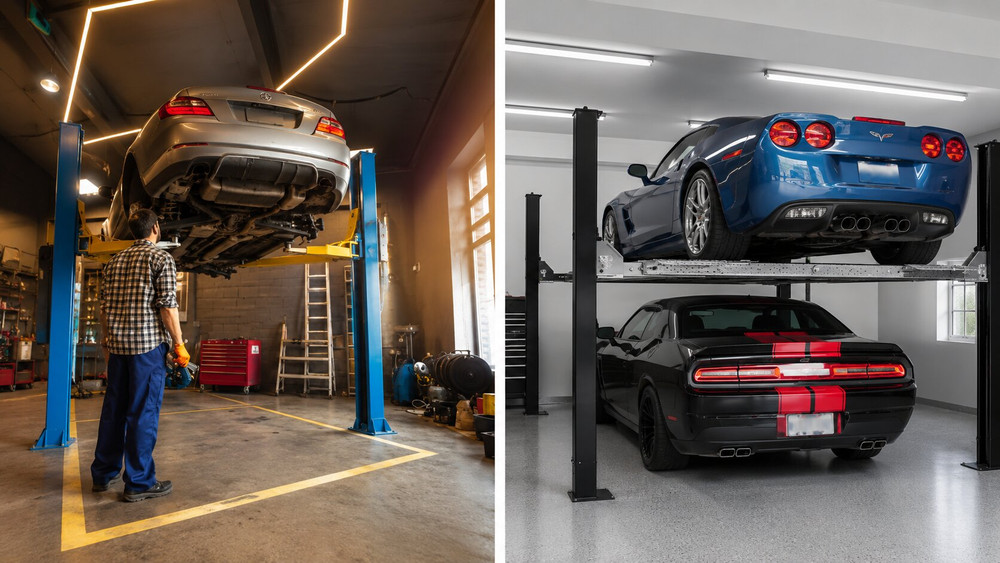
2-Post vs 4-Post Lift: Pros, Cons & Which to Buy (2026)
Posted by Juan E. Chavez on 14th Nov 2026
By Juan E. Chavez, CEO of JMC Automotive Equipment. Updated November 2026.
Short answer: buy a 2-post lift if you mainly repair cars (brakes, suspension, exhaust, oil changes) and want the wheels hanging free. Buy a 4-post lift if you mainly want to store a second car, do alignments, or need a lift that is quick and easy to load. If you do both, a 4-post with a rolling jack covers most of it, and many shops end up owning one of each.
We have sold lifts to home garages and professional shops for close to 20 years. The questions below are the ones customers ask us on the phone before they buy, and the numbers come from the spec sheets of lifts we actually sell.
The Difference in One Minute
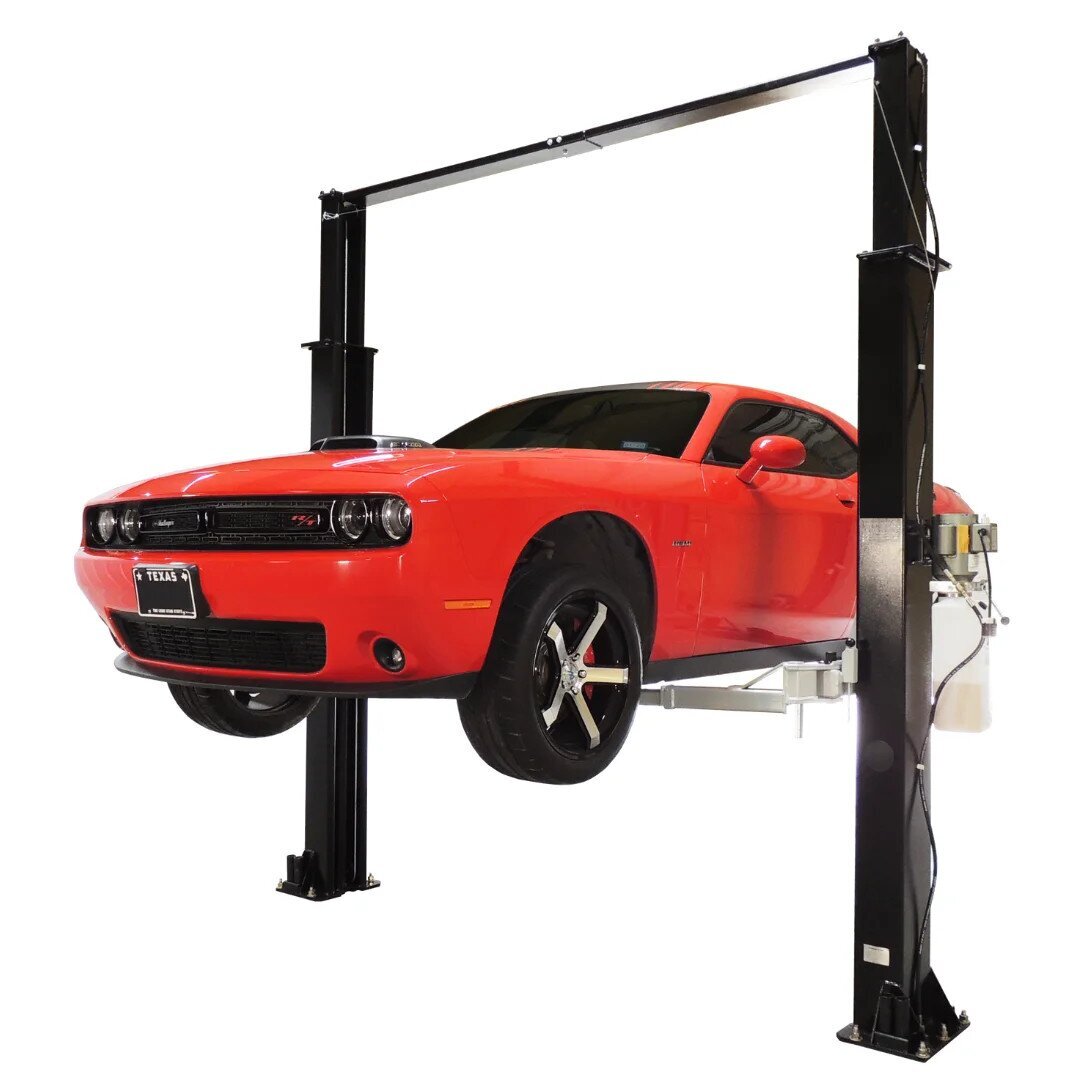
A 2-post lift has two columns, one on each side of the car. Four swing arms slide under the frame and lift the car by its lift points, so the wheels hang free. That gives you full access to wheels, brakes, suspension and the whole underside.
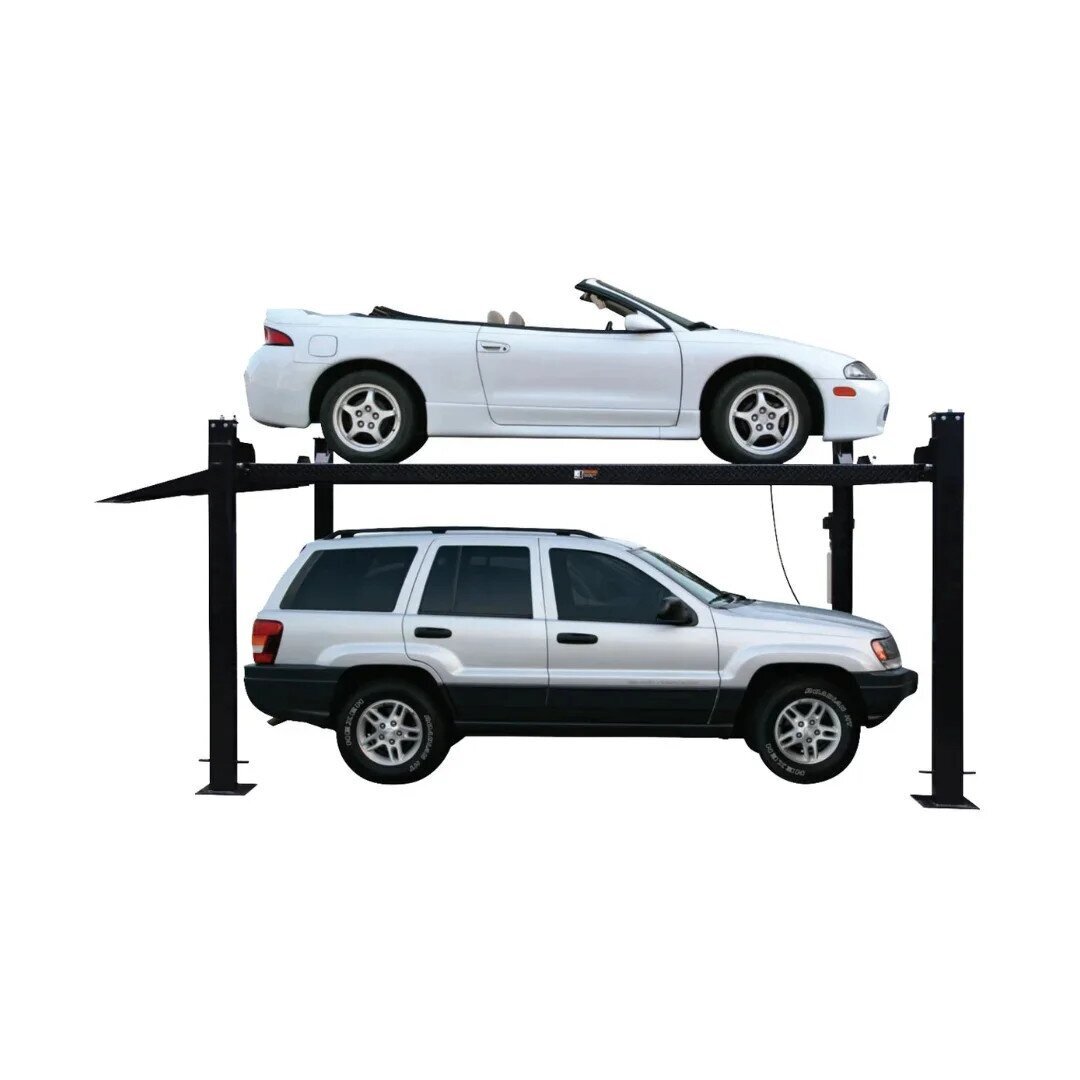
A 4-post lift has four columns and two runways. You drive onto the runways and the car is lifted on its own tires. That makes it stable, fast to load and safe for long-term parking, but the wheels and the middle of the car are blocked unless you add a rolling bridge jack.
2-Post vs 4-Post: Side-by-Side
| Factor | 2-Post Lift | 4-Post Lift |
|---|---|---|
| How the car is held | By the frame, wheels hang free | On its tires, on runways |
| Best for | Repair: brakes, suspension, exhaust, tires | Storage, alignment, oil changes, quick inspections |
| Wheel and suspension access | Full | Only with a rolling jack added |
| Long-term parking | Not recommended | Yes, designed for it |
| Footprint | About 11 to 12 ft wide, takes little depth | About 9 ft wide, 17 ft long with ramps |
| Ceiling height | Usually 12 ft for a clear-floor model; floorplate models fit around 9 ft 4 in | Depends on what you stack; 11 ft is a common target for storage |
| Concrete | Anchored; most 9,000 to 10,000 lb models call for at least 4 in of 3,000 PSI concrete | Spreads the load over 4 base plates; many home models can be freestanding |
| Loading | Need to set 4 arms at the right lift points | Drive on, set the parking brake |
| Can it be moved? | No, bolted to the slab | Some models, with an optional caster kit |
| Typical entry price | About $2,150 (9,000 lb) | About $2,900 (8,000 lb) |
Always confirm against the spec sheet and installation manual of the exact model you are buying.
Measure Your Garage First
Most of the bad lift purchases we see come from skipping this step. Here is what to measure, using two of our most popular home lifts as examples.
Ceiling Height
- 2-post clear-floor lift: the JMC9KAC-TUX stands 142-11/16 in tall overall (just under 12 ft) because the overhead beam carries the hoses and cables. Plan on a 12 ft ceiling.
- 2-post floorplate lift: the AMGO BP-9X has no overhead beam and stands 111-7/8 in (about 9 ft 4 in). The trade-off is a low plate across the floor between the columns that you drive over.
- 4-post storage lift: the JMC8K-DX stands 86 in tall and lifts the runways to 74-3/4 in. To park a car on top, add the height of the top car plus a few inches of margin. A typical sedan around 58 in tall puts you near 11 ft. An SUV or truck on top needs more.
- Working under the car: for a 2-post, also think about your own height. A full rise of about 6 ft under the car lets most people stand up straight.
Width and Length
- The JMC9KAC-TUX is 141 in wide overall with the power unit (11 ft 9 in), with 110-3/8 in between columns. Leave room to walk around it and open doors.
- The JMC8K-DX is 103-1/2 in wide (8 ft 8 in) and 207 in long with ramps (about 17 ft 3 in). Length is usually the tight dimension in a one-car garage, so measure to the wall and the garage door track.
Concrete
A 2-post lift puts all of the car's weight on two small base plates, so the anchors need solid concrete. Most 9,000 to 10,000 lb 2-post lifts call for at least 4 in of 3,000 PSI concrete with no cracks or seams near the anchors. Heavier lifts need more. If you are not sure what your slab is, drill a test hole or ask your installer before you order.
A 4-post spreads the load across four base plates, which is why many home 4-post lifts can sit freestanding. Anchoring is still the better choice for heavier vehicles or in a commercial shop.
Power
Most home and light-shop lifts in this range run on a 208 to 230V single-phase power unit, so check that you have, or can add, a 220V circuit near where the power unit will sit.
2-Post Lift Pros and Cons
Pros
- Full access to wheels, brakes, suspension, exhaust and the underside
- Small footprint: it takes up little floor depth, so the rest of the bay stays usable
- Lower entry price than a comparable 4-post
- Asymmetric models let you open the doors wide while the car is on the lift
Cons
- Not for long-term parking or stacking cars
- You have to place four arms at the correct lift points every time, which takes practice
- Needs a solid, anchored slab
- Clear-floor models need a tall ceiling
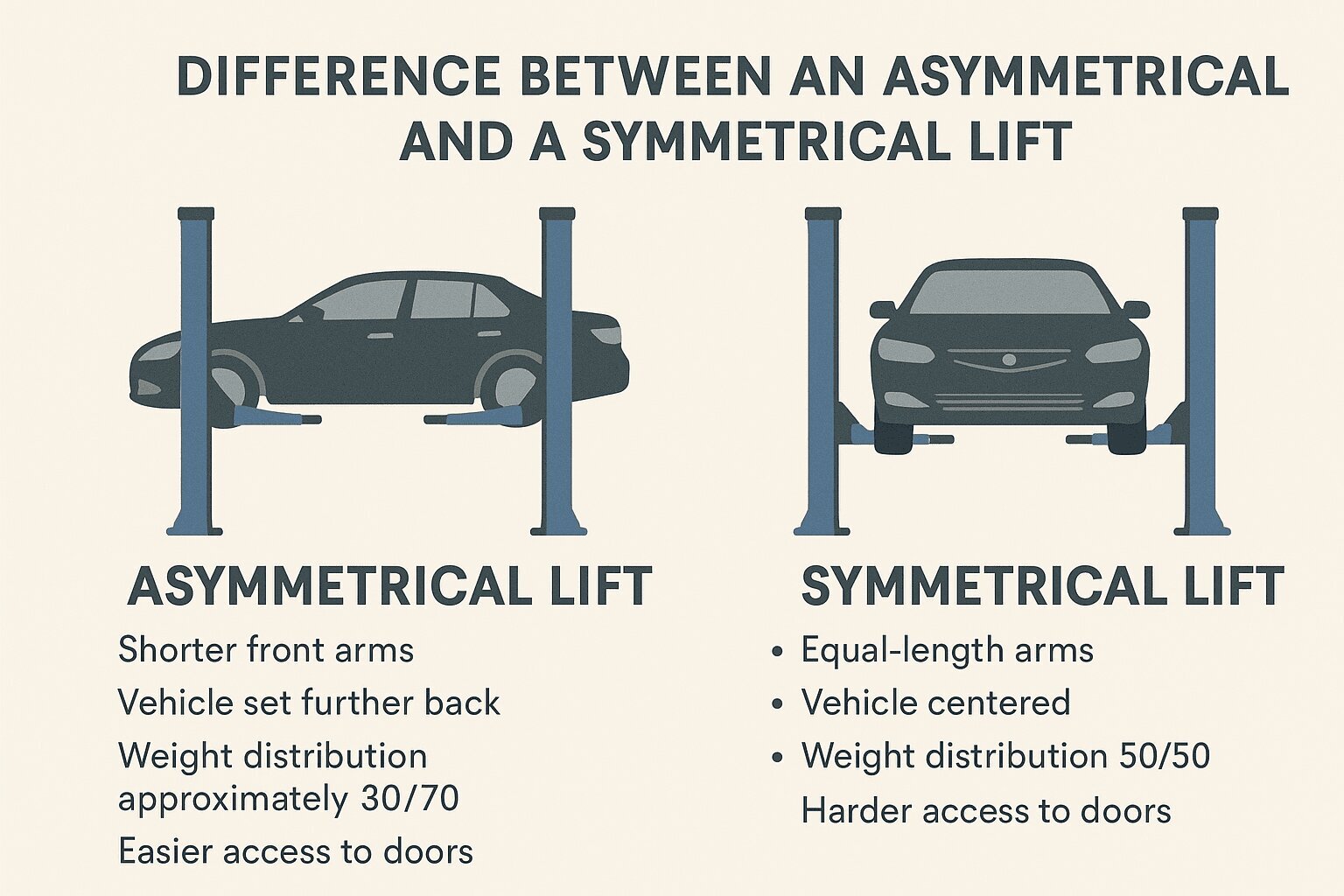
Symmetric or asymmetric? Symmetric lifts center the car and handle trucks and long wheelbases well. Asymmetric lifts set the car further back so the doors open freely, which suits most passenger cars. Our symmetric vs asymmetric guide goes deeper.
4-Post Lift Pros and Cons
Pros
- Doubles parking: store one car on top and park another underneath
- Drive on and go: no lift points to find, which makes it easy for beginners
- Stable for alignments, oil changes, exhaust and inspections
- Many home models do not need anchoring, and some can be moved with a caster kit
Cons
- The wheels and the center of the car are blocked unless you add a rolling bridge jack
- Takes more floor space, especially length
- Higher entry price, plus the cost of jacks and drip trays if you want to do repair work
What It Really Costs
The lift price is only part of it. When you budget, include:
- The lift: about $2,150 for a 9,000 lb 2-post and about $2,900 for an 8,000 lb 4-post at current pricing
- Installation: professional install is common for 2-post lifts because of the anchoring and arm setup. 4-post lifts are simpler, and many owners install them with a helper
- Electrical: a 220V circuit if you do not already have one near the lift
- Concrete work: only if your slab is too thin or cracked where the posts go
- Accessories for a 4-post: a rolling bridge jack, drip trays and caster kit if you want them
In the New York area (Long Island, all of NYC and Westchester), our sister company Automotive Facility Service installs lifts. Elsewhere, we can point you to installation options when you order.
Which Is Better for a Home Garage?
Ask yourself what you will do most:
- You wrench on your own cars (brakes, suspension, exhaust, tire rotations): get a 2-post. If your ceiling is under 12 ft, look at a floorplate model.
- You need more parking or want to keep a project or weekend car out of the way: get a 4-post.
- You want both: a 4-post with a rolling bridge jack is the most flexible single lift for a home garage.
Which Is Better for a Professional Shop?
For general repair bays, the 2-post is the workhorse. It gets cars on and off fast and gives techs full access for the jobs that pay the bills: brakes, suspension, exhaust and tires.
A 4-post earns its place for alignment work, oil-change and inspection lanes, and parking customer cars overnight without tying up a repair bay. Heavy-duty 4-post lifts also handle trucks and fleet vehicles that are awkward on frame-contact arms.
If you can only add one lift, follow your service mix: mostly repair points to a 2-post, mostly alignment and quick service points to a 4-post.
Decide in 30 Seconds
- Will a car stay on the lift overnight or longer? 4-post.
- Do you need the wheels off the ground for brakes or suspension? 2-post (or a 4-post plus a rolling jack).
- Is your ceiling under 12 ft? 4-post or floorplate 2-post.
- Is your slab thin or cracked and you do not want to fix it? Freestanding 4-post.
- Is your garage short front to back? 2-post.
Lifts Worth a Look
| Type | Model | Capacity | Best for | Price |
|---|---|---|---|---|
| 2-Post, clear floor | JMC Equipment JMC9KAC-TUX | 9,000 lb | Home garage with a 12 ft ceiling | $2,156 |
| 2-Post, floorplate | AMGO BP-9X | 9,000 lb | Lower ceilings, symmetric | $2,920 |
| 4-Post | JMC Equipment JMC8K-DX | 8,000 lb | Home storage and service | $2,899 |
| 4-Post | BendPak HD-9 | 9,000 lb | Heavier-duty storage and service | $6,095 |
| Heavy-duty 4-Post | BendPak HDSO-14P | 14,000 lb | Trucks, fleet, commercial shops | $10,995 |
Prices as of November 2026. JMC Equipment models are on Black Friday pricing through November 27.
Still comparing lift types? Our hydraulic car lift guide also covers scissor, mid-rise and portable lifts.
Talk to Us Before You Buy
Send us your ceiling height, garage width and length, and the cars you will lift, and we will tell you which lifts fit. Call 800-562-4791 or contact us. You can also browse all 2-post lifts and 4-post lifts.
FAQ
Is a 2-post or 4-post lift better for a home garage?
It depends on use. A 2-post is better if you do your own repairs, because the wheels hang free. A 4-post is better if you want to store a second car or need a lift that is easy to load. If you want both, a 4-post with a rolling bridge jack is the most flexible choice.
What are the pros and cons of a 4-post lift?
Pros: it holds the car on its tires so it is safe for long-term storage, it is easy to load with no lift points, it is stable for alignments, and many home models do not need anchoring. Cons: it takes more floor space, it costs more, and you cannot reach the wheels or suspension without adding a rolling jack.
How much ceiling height do I need for a 2-post lift?
A clear-floor 2-post with an overhead beam usually needs about 12 ft; the JMC9KAC-TUX is 142-11/16 in tall. A floorplate 2-post has no overhead beam and can fit around 9 ft 4 in, like the AMGO BP-9X at 111-7/8 in.
How much ceiling height do I need for a 4-post storage lift?
Add the lift's maximum runway height to the height of the car on top, plus a few inches of margin. With a 74-3/4 in runway height and a 58 in tall sedan on top, plan on about 11 ft.
Can I leave a car on a 2-post lift?
Not for long periods. A 2-post holds the car by its frame with the suspension hanging, so it is meant for working, not parking. For storage, use a 4-post, which holds the car on its tires.
What concrete does a 2-post lift need?
Most 9,000 to 10,000 lb 2-post lifts call for at least 4 in of 3,000 PSI concrete with no cracks or seams near the anchors. Heavier lifts need thicker concrete. Always follow the installation manual for your model.
Can you do an alignment on a 2-post lift?
Not properly. Alignments need the car sitting level on its tires, which is what a 4-post alignment lift is built for. That is one of the main reasons shops add a 4-post.
 CALL US NOW
