
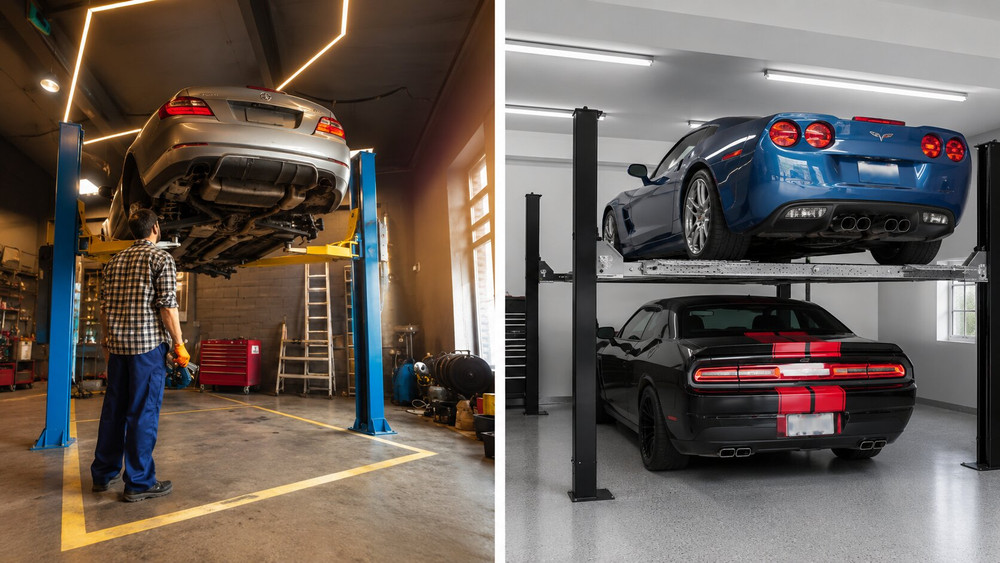
2-Post vs 4-Post Lift: Which Is Better for Your Garage or Shop?
Posted by JMC Team on 9th May 2025
Choosing a lift sounds simple until you actually start comparing options. Two-post or four-post. Symmetric or asymmetric. Storage or repair.
Each choice changes how the lift performs, what it costs, and what kind of work you can actually do once a vehicle is in the air. Get it wrong and you're stuck with a lift that doesn't fit your space, your budget, or the job you bought it for.
We’ll share the real differences between 2-post and 4-post lifts so you can make that call with confidence, whether you're outfitting a home garage or planning a full-service bay.
2-Post Lifts: How They Work
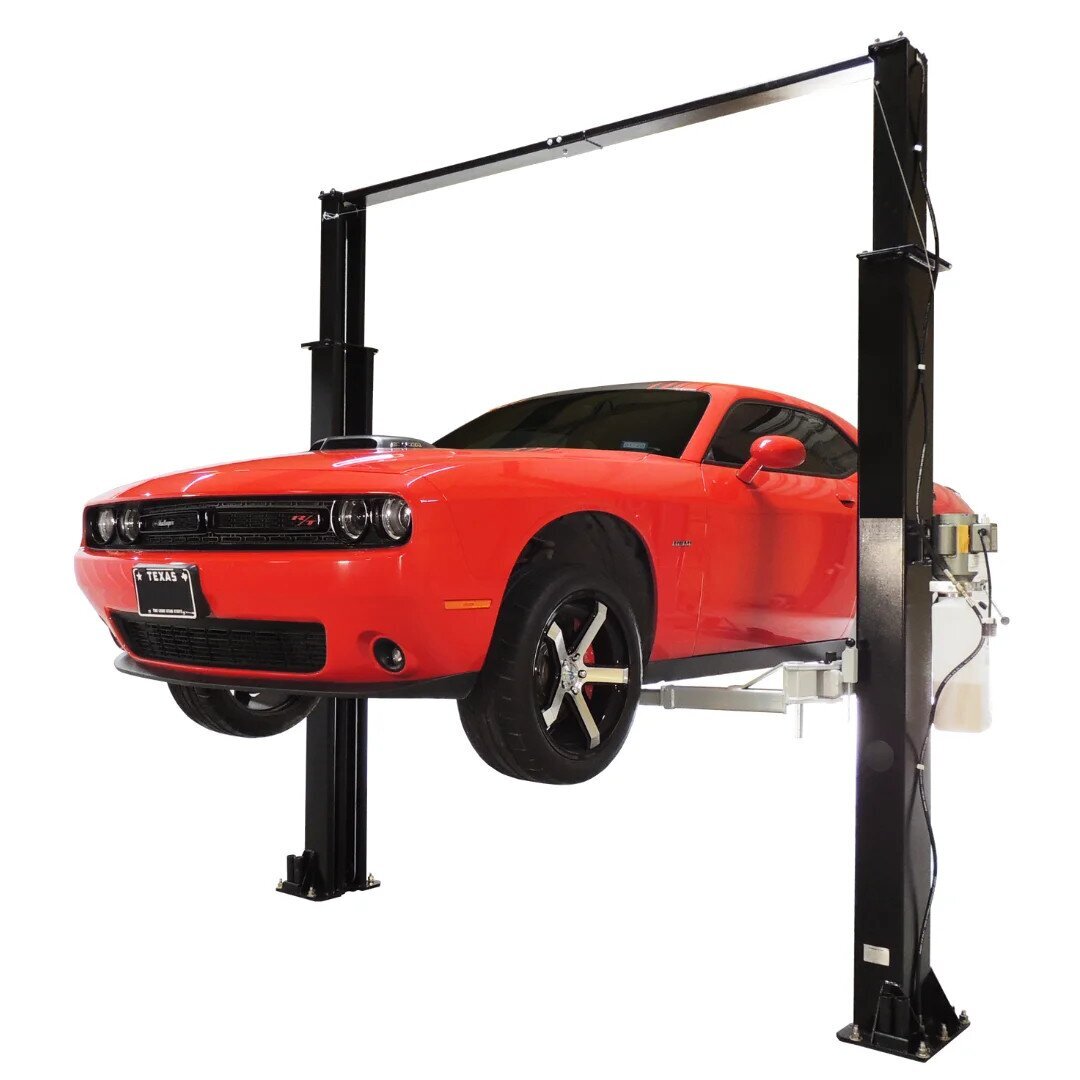
A 2-post lift uses two vertical columns positioned on either side of the vehicle, connected by swing arms that extend underneath the frame. Drive the car between the posts, position the arms at the manufacturer's lift points, and the vehicle rises off the ground entirely. No wheels touching anything.
That's what makes 2-post lifts the go-to choice for repair work. With the car suspended by its frame, you get total access to the underside, the wheels, the brakes, and the suspension components, all without anything blocking your way.
Symmetric vs Asymmetric: A Quick Distinction
Not all 2-post lifts position the vehicle the same way. Symmetric lifts use four arms of identical length, with the posts facing each other squarely. The car sits centered between them, weight split evenly front to rear, roughly 50/50. Asymmetric lifts use shorter front arms and columns rotated outward at an angle, which shifts the car slightly forward and opens up the doors for easier access. That configuration puts more of the vehicle's weight toward the rear arms, typically a 30/70 split.
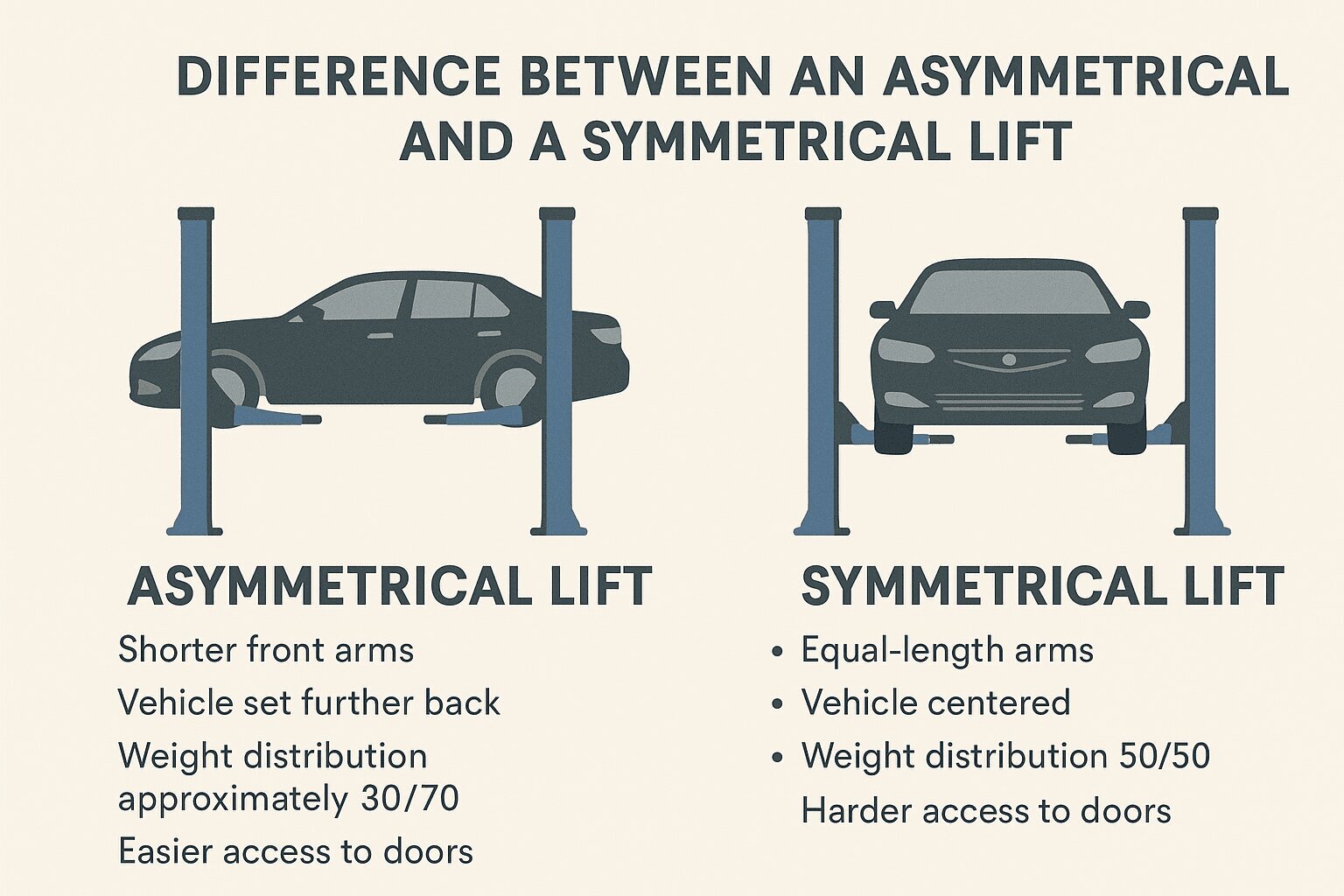
Which one fits your situation depends on what you're driving and how often you need full door access while the car's in the air. We cover the differences in much more depth in our dedicated guide, Symmetric vs. Asymmetric Two-Post Car Lift: What's the Difference?, worth a read before you commit to either style.
2-Post Lift Pros
- Smaller footprint than a 4-post, more usable floor space around the lift
- Full undercarriage access for brake jobs, suspension work, and exhaust repairs
- Generally the more affordable option, especially in the 9,000 to 10,000 lb range
- Faster to position a vehicle compared to driving onto runways
2-Post Lift Cons
- The vehicle isn't sitting on its own wheels, so it can't be used for long-term storage
- Leaving a vehicle raised on a 2-post lift for extended periods can put unwanted strain on suspension components, since the frame is bearing weight in a way it wasn't designed for at rest
- Requires precise frame contact points, which means a slightly steeper learning curve for new users
- Almost always needs to be anchored into a properly reinforced concrete slab
Best suited for: shops and home garages focused on repair work, brake jobs, suspension, and general maintenance where undercarriage access matters most.
4-Post Lifts: How They Work
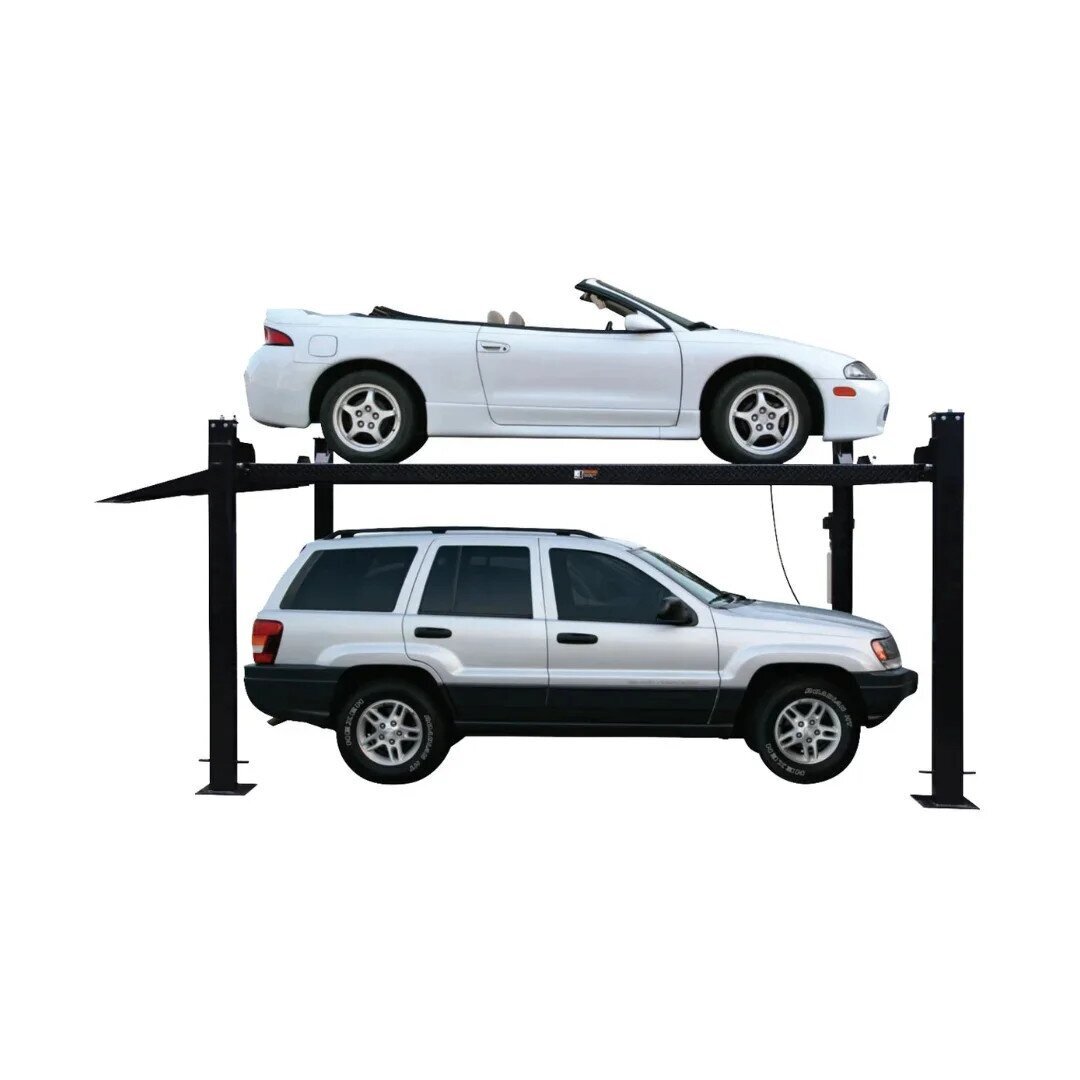
A 4-post lift trades undercarriage access for stability. Instead of frame contact points, the vehicle drives up onto two long runways supported by four corner columns, so it's resting on its own wheels the entire time it's raised.
That makes 4-post lifts a natural fit for two very different jobs: vehicle storage and alignment work. If you want to park a second car in the vertical space above your daily driver, or you need a stable platform that doesn't depend on hitting exact lift points, a 4-post lift handles both without much fuss.
Most 4-post setups also include the option to add a rolling bridge jack between the runways, which lifts the vehicle off its wheels when you do need underside access, giving you a bit of the best of both lift types in one unit.
4-Post Lift Pros
- Vehicle sits on its own wheels, ideal for storage and stacking two vehicles vertically
- No need to hit precise frame lift points, easier for less experienced users
- A stable, wide platform well suited for alignment work
- Often a better fit when ceiling height is limited, since many 4-post models run lower overall
- Many models don't require floor anchoring at all, and some can be fitted with a caster kit for moving the lift around the garage when not under load (though anchoring is still recommended for heavier vehicles)
4-Post Lift Cons
- A much wider footprint, takes up more floor space than a 2-post
- Without an added bridge jack, you don't get full access to the wheels and undercarriage
- Generally a bigger upfront investment than a comparable 2-post lift
Best suited for: vehicle storage, alignment service, and shops or home garages that want a stable, easy-to-use platform without the precision frame work a 2-post requires.
2-Post vs 4-Post: Key Differences
Specific clearance and slab requirements vary by model and capacity, so always check the spec sheet for the exact lift you're considering before finalizing your garage layout.
Which Is Better for Home Garages?
For most home garage owners, it comes down to what you actually plan to do with the lift. If you're doing your own brake jobs, oil changes, and suspension work, a 2-post lift gives you the access you need in a smaller footprint, and it's usually the more budget-friendly entry point.
If your garage doubles as storage for a second vehicle, or you mostly want a stable platform without worrying about hitting exact lift points every time, a 4-post lift is the better fit, especially if ceiling height is tight.
Either way, measure your space first. Floor width, depth, and ceiling height all factor into which lift type will actually fit.
Which Is Better for Professional Shops?
Professional shops often end up with both. A 2-post lift remains the workhorse for general repair bays, fast vehicle turnover, and any job that needs full undercarriage access.
A 4-post lift earns its place for alignment work, vehicle storage between service appointments, and shops that handle a wide range of vehicle types where frame-engaging precision isn't always practical.
If your shop is choosing just one to start, base the decision on your primary service mix. Heavy repair and maintenance work points toward 2-post. Storage, alignment, and general service work points toward 4-post.
Quality Lift Options to Consider
Here's a snapshot of current 2-post and 4-post lifts across a range of budgets and capacities.
Prices reflect current promotional pricing at JMC Equipment and are subject to change.
Find the Right Lift at JMC Equipment
Both 2-post and 4-post lifts earn their place in a well-equipped garage or shop. The right call comes down to matching the lift to your space, your vehicles, and the kind of work you're actually doing day to day.
We stock 2-post, 4-post, and heavy-duty 4-post lifts from trusted brands including BendPak, Challenger, AMGO, and JMC Equipment's own lineup, with free shipping on qualifying orders and installation support nationwide.
Browse the full 2-post lift collection or 4-post lift collection at JMC Equipment, or call 800-562-4791 to talk through which lift fits your space.
Frequently Asked Questions
Are 2-post lifts safe for home garages?
Yes, as long as the lift is properly installed on a slab that meets the manufacturer's thickness and reinforcement requirements, and the columns are anchored correctly. ALI-certified lifts with dual safety locks and automatic arm restraints are built specifically with home and shop safety in mind.
What's the lifespan of a 2-post or 4-post car lift?
With regular maintenance, both types typically last well over a decade in a home garage setting, and often longer in a shop with proper upkeep. Cables, pulleys, and hydraulic seals are the parts most likely to need replacing over time, so factor that into your long-term cost expectations regardless of which type you choose.
What's the cost difference between 2-post and 4-post lifts?
Entry-level 2-post lifts in the 9,000 lb range typically start lower than comparable 4-post models, often by $1,000 to $3,000 depending on brand and features. Heavy-duty 4-post lifts built for trucks and commercial use climb well into five figures.
Can I install a 2-post lift in a garage with a low ceiling?
It depends on the specific model. Some 2-post lifts are designed with a lower overall height to accommodate tighter ceilings, but full-rise units generally need more vertical clearance than most 4-post or portable alternatives. Check the exact overall height listed on the model you're considering.
Do 4-post lifts require less concrete reinforcement than 2-post lifts?
Often, yes. Because the load is spread across four columns and a wider runway footprint rather than concentrated at two anchor points, some 4-post lifts have more forgiving floor requirements, and many don't require floor anchoring at all. That said, anchoring is still recommended for heavier vehicles even on a 4-post setup, and requirements vary by model and capacity, so check the manufacturer's specs rather than assuming.
Can a 4-post lift be moved once it's installed?
Some can. Unlike a 2-post lift, which is almost always bolted permanently to the slab, certain 4-post models can be fitted with an optional caster kit that lets you roll the lift to a different spot in the garage when it's not under load. It's a useful feature if your space needs change, but not every 4-post model supports it, so check before assuming.
Is it bad to leave a car on a 2-post lift for a long time?
Yes, generally. Because a 2-post lift suspends the vehicle by its frame rather than its wheels, leaving it raised for extended periods can put strain on suspension components that aren't designed to bear weight that way at rest. For long-term storage, a 4-post lift is the better choice since the vehicle sits on its own wheels just as it would on the ground.
Which lift is easier to install, 2-post or 4-post?
4-post lifts are generally considered more straightforward to install, since there's no frame-engaging precision involved and the runway design tends to be more forgiving of minor floor imperfections. 2-post lifts usually call for professional installation given the anchoring and arm calibration involved.
 CALL US NOW
