This category holds 50 machines for bending and finishing tube, pipe, bar and profile, from seven brands: Baileigh (36 listings), GMC Machine Tools (6), Huth (3), Zinko (2), BendPak, Lisle and Huth-Ben Pearson International. Twenty-three are benders, one is a replacement bending die, and the other twenty-six sit beside a bender in the same cell: tube and pipe notchers, bead rollers, corner notchers, power hammers, a finger brake, a shrinker/stretcher and welding turning rolls. Bending capacity runs from 3/16 in. OD tubing up to 4 in. tube, on machines ranging from a hand bender that mounts in a vise to floor-standing equipment weighing over a ton.
Buyers arrive here looking for very different machines under the same words. "Pipe bender" can mean a 12-ton hand unit or a hydraulic rotary draw bender with a digital stop. "Automotive tube bending" usually means exhaust and header work, which needs a bender that also expands and swages ends. Ring rollers mean large-radius rolling, not tight-radius die bending. Picking the wrong one of those three is the most expensive mistake here.
▸ Read the full Tube & Pipe Benders buying guide — types, capacity, power and space, comparison table and FAQs
The four bending methods in this category
Rotary draw benders
The Baileigh RDB series draws tube around a fixed die, so the centerline radius (CLR) is set by the die, not the operator. Four are listed: the RDB-125-CSA110V (hydraulic ratcheting, 2 in. schedule 40 pipe), the RDB-150-CSA110V (2 in. schedule 40 pipe, 8 in. CLR maximum), the RDB-150-AS-CSA110V (adjustable automatic stop) and the RDB-175-CSA110V (high speed, digital auto stop). All four are 110 V machines, the voltage coming from the CSA110V model code rather than from a published electrical spec, and none of the four listings states a phase. The RDB-125, RDB-150 and RDB-150-AS listings state CSA-compliant components and wiring; the RDB-175 carries the same CSA110V suffix but its listing does not repeat the statement, so ask us to confirm it before ordering. This is the method for tight, repeatable bends at one radius all day.
Exhaust and fabrication bender-expanders
Ram-style hydraulic machines with knee-pedal control and a depth-of-bend indicator, built for muffler shops and structural fabrication. The BendPak BB-2 Blue-Bullet handles tube up to 3 in. (76 mm) at a .095 in. wall, at a bending radius from 3.3 in. to 5 in., on 60,000 lbs of top-cylinder force. The Huth Ben Pearson HB-05 Essentials Package (bender model 1605 plus the 023 die package) puts 58,000 lbs behind 2 in. to 3 in. tubing. The Huth 2650 and 2660 are the fabrication versions without a swager, at 58,000 lbs on a 5 in. cylinder and 85,000 lbs on a 6 in. cylinder, both able to bend round, square or rectangular tubing and pipe; the 2650 listing also names flat bar, and both offer custom tooling for flat stock as an option.
Roll benders and ring rollers
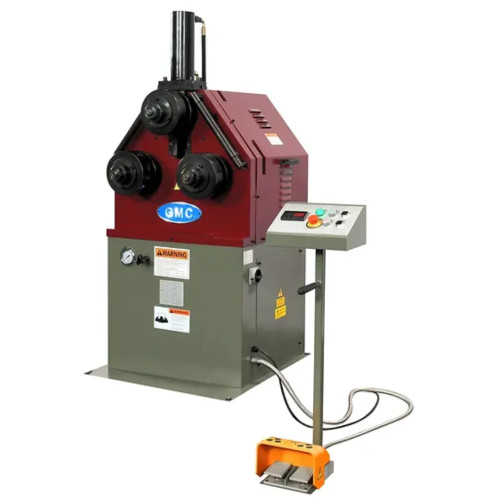
Three-roll machines that walk material through repeatedly to sweep large radii and full rings. Baileigh lists the R-M55-CSA220V (220 V single phase), the R-M60-HD and the R-H60-HD. Both of the HD machines drive all three rolls on an industrial-grade hydraulic motor; what separates them is the top roll and the tipping. The R-M60-HD positions its top roll with a ratchet and tips manually (2 in. square x .120 in. wall tubing, 2 in. schedule 40 pipe); the R-H60-HD positions it hydraulically, tips hydraulically, adds a digital readout with programmable stop, and takes 2.5 in. schedule 40 pipe. GMC lists five: the PRB-55 with manual top-roll positioning; the PRB-55-1ph, whose name says manual but whose feature list and spec table describe the hydraulic PRB-55H-1ph (confirm the configuration with us before ordering); the PRB-55H and PRB-55H-1ph with hydraulic positioning and a digital readout; and the PRB-75H rated for 4 in. tube and 3-1/2 in. pipe.
Hand, bench and ornamental benders
The Zinko ZPB-1202 (2 in.) and ZPB-1503 (3 in.) are portable manual benders, listed on request rather than for online purchase; call us for availability. The ZPB-1202 listing states a 12-ton capacity and that die sets are sold separately as a set of six; the ZPB-1503 listing does not publish its tooling, so confirm the die package before you order. The Lisle 44000 is a hand tubing bender for 3/16 in., 1/4 in., 5/16 in. and 3/8 in. OD tubing, with a nylon form that prevents kinking or flattening, though its listing states it is not recommended for 3/8 in. steel. Baileigh's manual ornamental line works flat bar and solid stock rather than tube: the MCB-650 bends up to 5/16 in. x 1.25 in. stainless or .25 in. x 2 in. mild steel with seven die sets included, the MPB-10 scrolls up to 1-1/8 in. x 3/8 in. wrought iron, the MPB-15 takes 5/8 in. round and 1-3/16 in. x 5/16 in. flat bar, and the MPB-40 adds shearing, punching and twisting.
What the capacity number does not tell you
Three specifications decide whether a machine makes your part, and only one is the headline number.
- Centerline radius. A draw bender is limited by its dies. The RDB-150-CSA110V tops out at an 8 in. CLR; the BendPak BB-2 works between a 3.3 in. and a 5 in. radius. A radius outside that window is impossible regardless of diameter capacity.
- Minimum rolled diameter. Roll benders have a floor, not just a ceiling. The GMC PRB-55 table lists a 24 in. minimum diameter for 2 in. schedule 40 pipe, 2-1/2 in. x 14 ga. round tube and 2 in. square tube; 20 in. for 2-3/8 in. x 3/8 in. flat bar; 36 in. for 4 in. x 9/16 in. flat bar; and 47 in. for 2-3/4 in. x 2 in. x 3/8 in. angle. One machine, thirteen published capacities and six different minimum diameters: 20 in., 24 in., 26 in., 28 in., 36 in. and 47 in., depending on the profile and, for angle, T-iron and channel, on whether the leg goes in or out. On the same 2 in. x 3/16 in. angle, that orientation moves the minimum from 28 in. leg-in to 20 in. leg-out.
- Wall thickness. Capacity is always quoted against a wall: the BB-2 figure is 3 in. at .095 in., the R-M60-HD and R-H60-HD 2 in. square at .120 in., the GMC round-tube rating 2-1/2 in. at 14 ga. Heavier wall on the same diameter is a different job.
Tooling is the fourth variable, and it is rarely included in full. The BB-2 ships with the Deluxe 302 package, listed in its table as 1.5 in., 1.625 in., 1.75 in., 2 in., 2.25 in. and 2.5 in.; a 3 in. package and a metric package are sold separately. The HB-05 includes the 023 package, and Huth radius dies are sold individually. On the GMC PRB-75H, read the standard-equipment note: the included universal rollers cover most work except round tube and pipe.
Power, air, space and freight
Electrical service is the most common installation surprise.
- 110 V: all four Baileigh RDB rotary draw benders (110 V from the CSA110V model code; the listings do not state a phase), the TN-300 (110 V single phase), the TN-800 and the BR-16E-36 bead roller.
- 220 V single phase: the BendPak BB-2 (5 HP, 208-230 VAC, 60 Hz), the Baileigh R-M55-CSA220V, R-M60-HD and R-H60-HD, the GMC PRB-55-1ph and PRB-55H-1ph, and the TN-200E, TN-400 and TN-600.
- 220 V, phase not published: the MSS-14H-CE220V shrinker/stretcher, 220 V from the model code, with nothing further published.
- Dual voltage: the MH-19 power hammer, whose feature list says 220 V single phase while its table lists 110 / 220 V, 1-phase -- confirm before wiring.
- 220 V three phase: the GMC PRB-55, PRB-55H and PRB-75H (440 V optional on two of them), the BBM-08E, the MH-37HD, all four RWP positioners and the SN-F04-MS and SN-F09-MS.
- Either, with an amperage note: the Huth HB-05 runs at 220 V / 60 Hz; single phase requires 30 amp service, three phase 20 amp.
- Compressed air: only the SN-F11-AN corner notcher, on any compressor delivering 90 to 115 PSI.
- No power: the Lisle 44000, both Zinko benders, the four MCB and MPB ornamental benders, the TN-50M, TN-125M, TN-200M and TN-250, the BF-035 and BR-18M-18, the SN-F16-FN and SN-F16-HN corner notchers and the BB-4012F brake.
The Huth 2650 and 2660 listings do not state a voltage; confirm it on the model's spec sheet before ordering. Ceiling height is published nowhere here, so plan from overall dimensions: the BendPak BB-2 is 42 in. wide x 62 in. deep x 31 in. high; the Huth 2650 and 2660 are 24 in. wide x 54 in. long, with a 42 in. bending plane height and a 10 gallon oil tank for multi-shift running; the GMC PRB-55 family is 40 in. x 35 in. x 65 in., the PRB-75H 51 in. x 45 in. x 72 in. Published weights run from 6 lbs for the vise-mounted BF-035 to 6,000 lbs for the MH-37HD power hammer, with the RWP-440 turning roll at 5,500 lbs, the BendPak BB-2 at 1,364 lbs and the PRB-75H at 2,450 lbs, and the BendPak listing states that unloading the freight is the buyer's responsibility. Nine listings are flagged for free shipping: the BendPak BB-2, the Huth HB-05, the Baileigh MH-37HD and all six GMC machines.
The rest of the fabrication cell
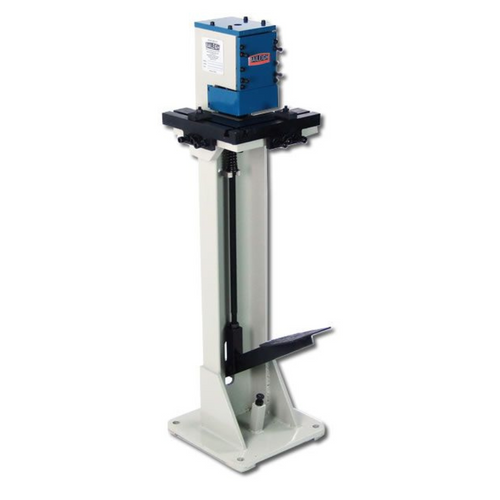
A bend is only half a joint. Nine tube and pipe notchers cover four coping methods. The manual notchers cut a fixed 90 degree notch at set pipe sizes, not across a range: the TN-50M copes .25 in., .375 in. and .5 in. schedule 40; the TN-125M handles .75 in., 1 in. and 1.25 in.; the TN-200M notches 1.5 in. and 2 in. If you need every size in between, the electric TN-200E makes the same fixed 90 degree notch but powered, from .25 in. to 2 in. schedule 40, one side at a time (rotate the pipe 180 degrees and reinsert for the second side). The TN-250 and TN-300 are hole-saw notchers, the TN-250 with a self-centering vise that clamps anywhere on the tube, including mid-bend, from .5 in. to 2.5 in. OD; the TN-400 and TN-600 are abrasive notchers at 3 HP and 5 HP; and the TN-800 is an end-mill notcher (patent 6,435,783) that copes 1 in. through 3 in. OD without changing tooling or hole saws. Around them sit four bead rollers, from the vise-mounted BF-035 (3/8 in. OD tubing, .035 in. maximum wall) to the GMC BBM-08E (8 ga. mild steel, 12 in. throat); the MH-19 and MH-37HD power hammers (19 in. and 37 in. throats); the BB-4012F finger brake (12 ga. across a full 40 in.); five corner notchers up to the SN-F04-MS (4 ga.); and four RWP turning rolls rated 5.5, 11, 22 and 44 tons.
Certifications and compliance
Only what the listings declare. GMC states ISO 9001 certification on all six of its machines. The RDB-125, RDB-150, RDB-150-AS and the R-M55 are listed with CSA-compliant components and wiring; the RDB-175 carries the same CSA110V model suffix but its listing does not repeat the statement, so ask us to confirm it before ordering. The MSS-14H-CE220V shrinker/stretcher is a CE model. BendPak states that all BB-2 cylinders use chrome-molly shafts conforming to ANSI 92.2, behind a NEMA-rated switch box with overload relays. Made-in-USA claims appear on six Baileigh listings: the BR-16E-36 bead roller, the MH-19 power hammer and the TN-300, TN-400, TN-600 and TN-800 notchers. Proposition 65 warnings appear on 32 of the 50 listings, all of them Baileigh, BendPak or Lisle; the GMC, Huth and Zinko listings carry none, and neither do the six Baileigh listings that publish no description at all -- the four RDB benders, the R-M55 and the MSS-14H. Absence of a warning on a page is not a statement that the product is exempt. No product here declares an ALI, ASME, OSHA or ETL certification, so do not assume one; if a certificate is a condition of purchase, request it in writing.
Where the listings disagree
Several listings contradict themselves. Where they do, the specification table is the figure to work from, and we confirm it with the manufacturer before the order goes out. The GMC PRB-55-1ph is named as the manual-positioning model but carries the PRB-55H feature list and a table headed "PRB-55H-1PH" with a 4 HP motor, while the PRB-55H-1ph listing shows 3 HP. The Baileigh MCB-650 opens by calling itself a roll bender for large pipes; its name and feature list describe a flat bar bender. The BendPak BB-2 is titled with the Deluxe 302 package and its table lists the 302 sizes as standard, but one paragraph refers to the BB-1 package. The Baileigh MH-19 states 220 V single phase in its feature list and 110 / 220 V, 1-phase in its table. The TN-300 gives a minimum notch capacity of .5 in. in its feature list and 5/8 in. in its table. The TN-50M gives its weight as 17 lbs on one line and 16 lbs on the next.
Bender comparison
| Model | Type | Rated capacity | Force / motor | Power |
|---|
| Lisle 44000 | Hand tubing bender | 3/16 to 3/8 in. OD tubing | Manual | None |
| Baileigh RDB-150 | Rotary draw | 2 in. sch. 40 pipe; 8 in. CLR max | Hydraulic | 110 V |
| BendPak BB-2 | Bender / expander / swager | 3 in. x .095 in. wall | 60,000 lbs; 5 HP | 208-230 V, 1 ph |
| Huth HB-05 (1605) | Bender / expander | 2-3 in. tubing | 58,000 lbs | 220 V; 30 A / 20 A |
| Huth 2660 | Fabrication bender | Round, square, rectangular tube | 85,000 lbs; 7-1/2 HP; 6 in. cylinder | Not stated |
| Baileigh R-H60-HD | Roll bender, hydraulic | 2 in. sq. x .120 in.; 2.5 in. sch. 40 | 3 driven rolls; DRO | 220 V, 1 ph |
| GMC PRB-55 | Ring roll, manual position | 2 in. sch. 40; min. dia. 24 in. | 3 HP | 220 V, 3 ph (440 V opt.) |
| GMC PRB-75H | Ring roll, hydraulic + DRO | 4 in. tube; 3-1/2 in. pipe | 5-1/2 HP | 220 / 440 V, 3 ph |
Frequently asked questions
Which bender do I need for exhaust and header work?
One that also finishes ends. Exhaust work needs expanding and swaging as well as bending, which is why the BendPak BB-2 includes two rear end-finishing units, a clampless swager and an internal expander, and the Huth HB-05 a heavy-duty expander. A rotary draw bender or a ring roller bends the tube but does not form the ends, and the Huth 2650 and 2660 are listed without a swager.
What is the difference between a roll bender and a rotary draw bender?
A rotary draw bender pulls tube around a fixed die for a tight, repeatable bend at the die's radius, such as the 8 in. maximum CLR on the RDB-150. A roll bender passes material through three rolls repeatedly to sweep a large radius or a full ring, which is why its critical spec is a minimum diameter, such as the PRB-55's 24 in. minimum for 2 in. schedule 40 pipe.
Can I run this equipment on standard shop power?
Some of it. All four Baileigh RDB benders run on 110 V. The BendPak BB-2 and the Baileigh roll benders need 220 V single phase, and the GMC PRB-55, PRB-55H and PRB-75H are three phase. The HB-05 needs 30 amp service on single phase, 20 amp on three phase.
Are dies included?
It depends. The BB-2 ships with the Deluxe 302 package, the HB-05 with the 023 package and the MCB-650 with seven flat-metal die sets. On the Zinko ZPB-1202 they are sold separately as a set of six; the ZPB-1503 listing does not say. On the GMC PRB-75H the standard rollers cover most profiles but not round tube and pipe. Check the standard-equipment list on each product page before you budget.
Do I need a separate notcher?
If you are welding tube to tube, yes. A bender shapes the run; a notcher copes the ends so they seat before welding. The manual TN-50M, TN-125M and TN-200M cover 1/4 in. through 2 in. schedule 40 at a fixed 90 degrees, but only at set sizes: .25 in., .375 in. and .5 in. on the TN-50M; .75 in., 1 in. and 1.25 in. on the TN-125M; 1.5 in. and 2 in. on the TN-200M. The electric TN-200E makes the same fixed 90 degree notch across .25 in. to 2 in. schedule 40. For angled notches, the TN-250 covers .5 in. to 2.5 in. OD, and the TN-300 and TN-800 reach 3 in. OD.
Is this equipment new?
Yes. JMC Automotive Equipment sells new equipment only. Every machine on this page is sold new; the brands shown are Baileigh, BendPak, GMC Machine Tools, Huth, Huth-Ben Pearson International, Lisle and Zinko. Every specification above comes from the current listings; where a figure is not published, confirm it with us first.






 CALL US NOW
