

Auto Repair Shop Equipment List & Cost to Open (2026)
Posted by Juan E. Chavez on 29th Oct 2021
Updated November 2026 · By Juan E. Chavez
Short answer: a general repair shop opens with a lift, an air compressor, a scan tool and floor tools (jacks, stands, a transmission jack, a shop press, an oil drain). From the JMC catalog that's about $9,300 in equipment for one bay. Add a second lift, a tire changer and a balancer and it's about $22,500. Alignment and a brake lathe for a three-bay shop take it to about $59,600. Installation, freight and electrical work come on top, and the whole shop (lease, buildout, insurance, working capital) typically runs $50,000–$250,000.
Search for an auto repair shop equipment list and you'll find twenty articles that say the same thing. Knowing what equipment exists was never the problem. The problem is what order to buy it in, and what it costs. This list is ordered by what each machine lets you bill, with real prices.
Before the list, one question
What work are you charging for in week one? A shop that lives on brakes and suspension needs one thing; a shop that lives on tires needs another, and a collision shop looks like neither. The most expensive mistake when you open isn't buying bad equipment. It's buying the right equipment at the wrong time.
The equipment list at a glance
| Equipment | When to buy | What it lets you bill | JMC price range |
|---|---|---|---|
| 2-post lift | Week one | Brakes, suspension, exhaust, oil, transmission | $2,111 to about $8,000 |
| Air compressor (5–10 HP, 80 gal) | Week one | Every air tool in the shop | $2,941–$5,595 |
| Diagnostic scan tool | Week one | Check-engine, ABS, airbag and electrical work | $249–$6,499 (Topdon AD700 to Autel Ultra S2) |
| Floor jacks and jack stands | Week one | A second car on the floor while the lift is busy | Jack from $476, stands from $80 a pair |
| Transmission jack | Week one | Transmission and clutch jobs | From $513 |
| Shop press | Week one | Bearings, bushings, ball joints | About $2,200 (22-ton) |
| Oil drain | Week one | Oil changes | $244–$507 |
| Tire changer | When tires are in the plan | Tire mounting | $1,541–$6,599 (swing arm) |
| Wheel balancer | With the tire changer | Balancing, finishing the tire job | $1,424–$8,499 |
| Brake lathe | Once brake volume justifies it | Rotor and drum resurfacing in house | $11,395–$13,095 |
| Alignment package | Once you have the customer volume | Alignments | $16,895–$25,000 |
What starts producing in week one
The lift. There's no substitute. Brakes, suspension, exhaust, transmission and oil work all run through it, and every one of those jobs bills better with the car in the air. It's also the purchase that costs the most to get wrong: once it's anchored to your slab, changing it means drilling again, often pouring concrete, with the bay down while it cures. Our 2-post lift placement guide covers the measurements.
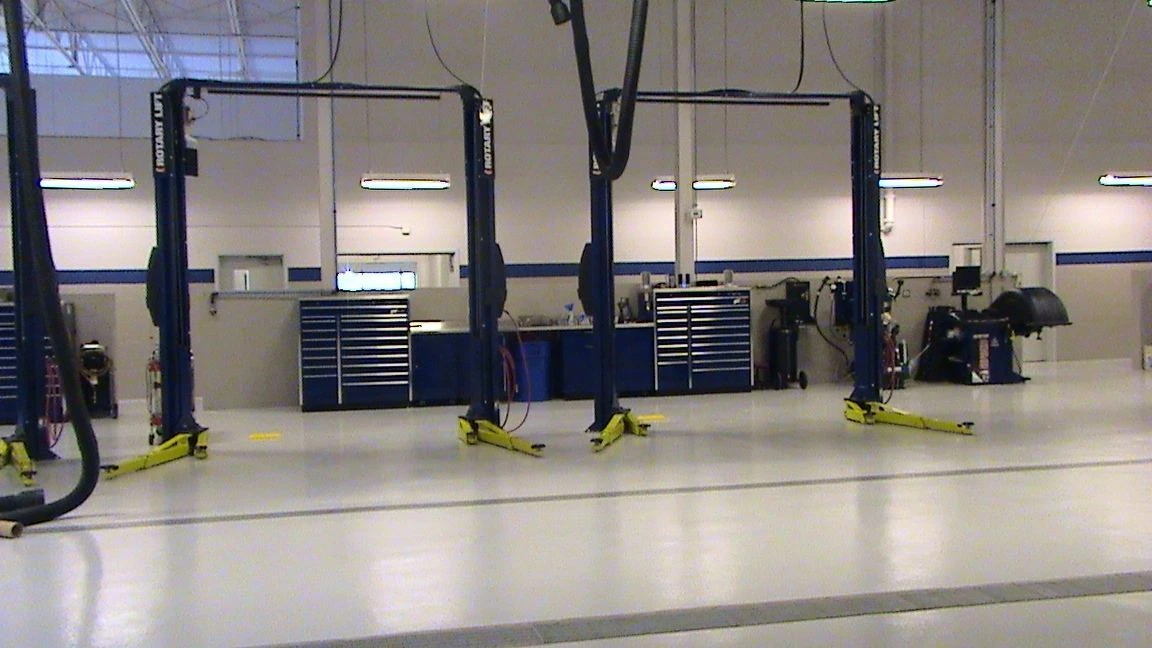
Two-post lift bays at a dealership in New Jersey. Installed by Automotive Facility Service.
The air compressor. Without air, the impact gun doesn't run. It's the equipment shops think about least and outgrow fastest, because air demand climbs with every tool and every tech. Buy a small one and you'll usually replace it inside a year. For a working shop, start at 5 HP and 80 gallons.
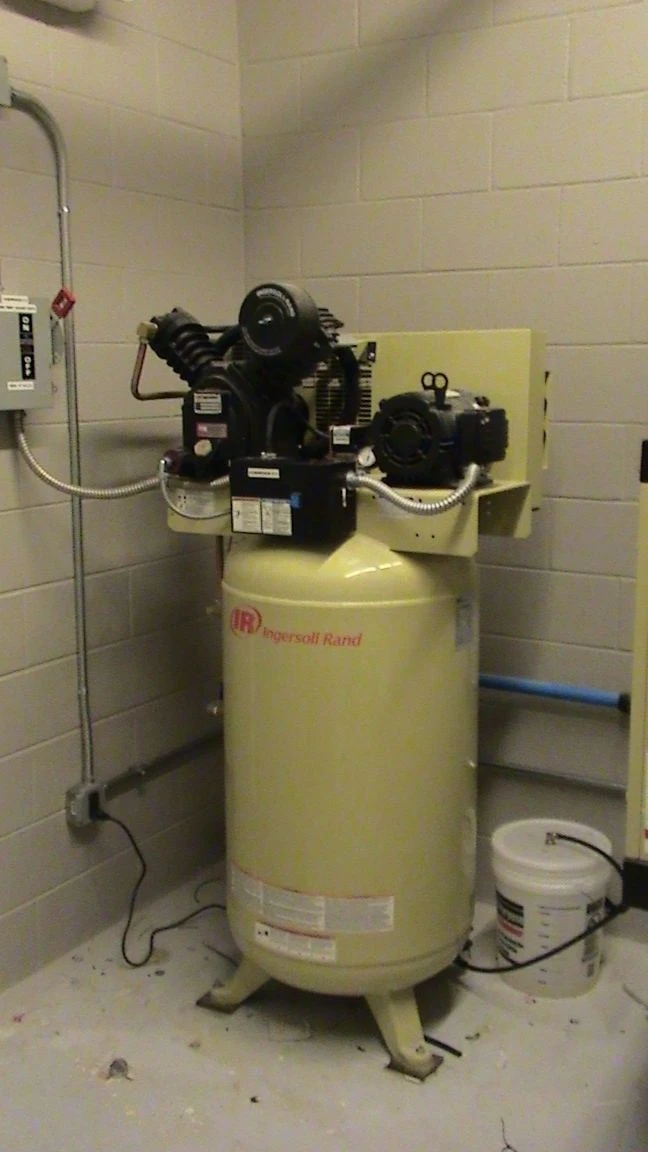
A vertical two-stage compressor with hard-piped air lines at a dealership in New Jersey. Installed by Automotive Facility Service.
Floor tools. Jacks, jack stands, a transmission jack and a press. While the lift is tied up, jacks and stands let you take a second car on the floor, and that second repair is revenue that would otherwise wait in line.
What starts producing when the second kind of work shows up
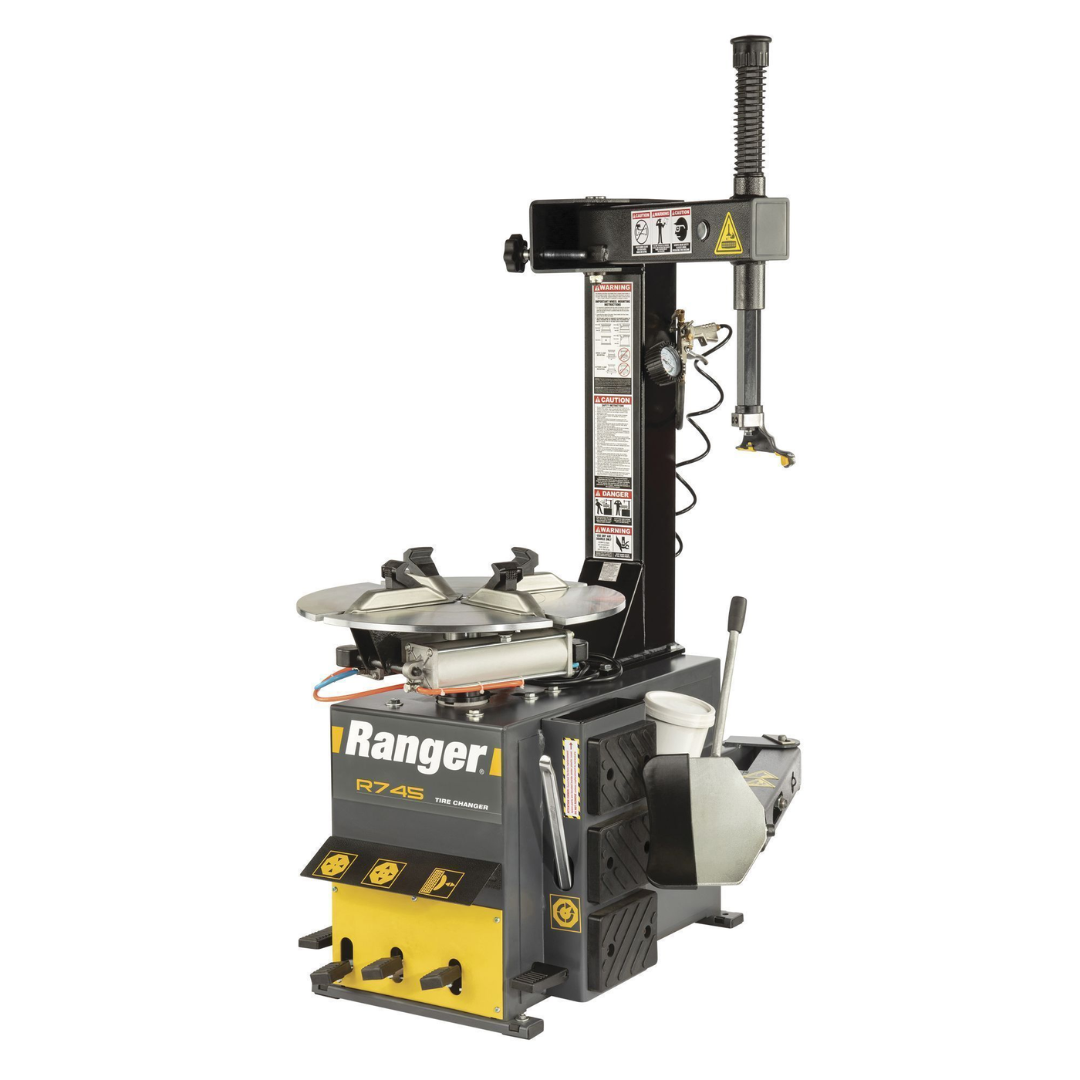
Tire changer and wheel balancer. They go together: mounting a tire without balancing it isn't a finished service. It's also the investment that brings customers back every season, and the customer who comes back twice a year for tires is the one who brings you the big jobs later. If tires are in your plan, this pair goes at the start.
Diagnostic equipment. A basic code reader starts around $249; a dealer-level tablet with ADAS runs $2,000–$6,500. How much you need depends on how new the cars coming through your door are. A shop surrounded by fleets and late-model vehicles needs it on day one; a shop working mostly on ten-year-old cars has room to build up to it.
What can wait, and why waiting isn't losing
Alignment. One of the most profitable machines a shop can own, and one of the most demanding in space, level floor and capital. An alignment bay needs a customer volume you don't have yet; until you do, it occupies floor another bay would be billing from.
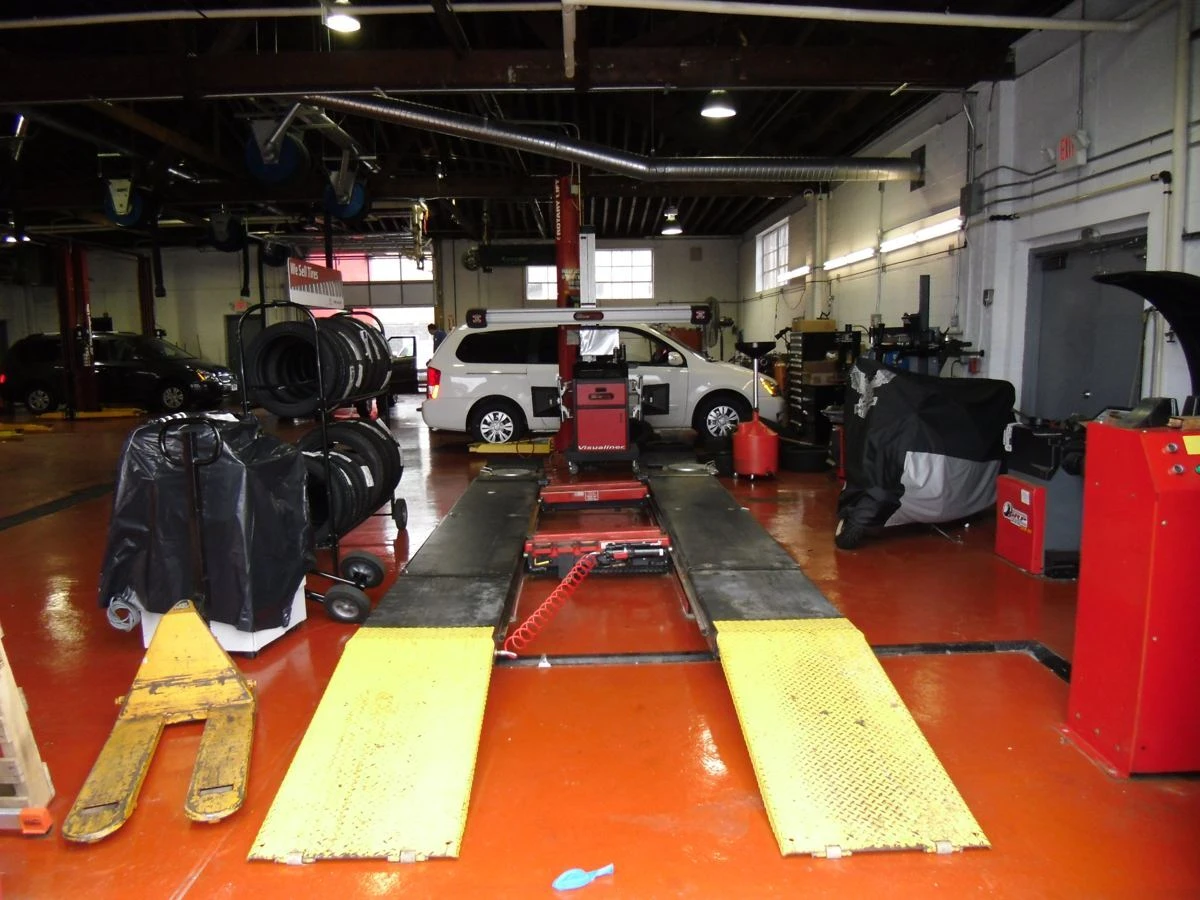
An alignment lift bay at a dealership in New Jersey. Installed by Automotive Facility Service.
Paint booth. If you're doing collision, this isn't an add-on, it's the business. It needs its own enclosed space, ventilation and permits, and it shapes the building from the floor plan up. If you're not doing collision, don't think about it yet.
Body repair equipment. Frame machines and rotisseries define what kind of shop you are; they don't add a service to the one you have.
Three starter packages with real prices
These are examples built from catalog prices, one model per line. Your mix will differ; the point is the order of magnitude.
| Equipment | 1 bay, general repair | 2 bays + tires | 3 bays + tires + alignment |
|---|---|---|---|
| 2-post lift (JMC9KFX, $2,188 each) | 1: $2,188 | 2: $4,376 | 2: $4,376 |
| Alignment lift and system (BendPak HDS-14LSX package) | $16,895 | ||
| Air compressor | Belaire 318HN 5 HP: $2,941 | Belaire 418VE 5 HP: $3,706 | EMAX 10 HP: $5,595 |
| Scan tool | GearWrench GWSMART07: $649 | Autel MS906 MAX ADAS: $2,075 | Autel Ultra S2: $6,499 |
| Tire changer | Ranger R745: $2,895 | APEX AT26A: $3,595 | |
| Wheel balancer | Cemb MOVE: $5,099 | Ranger LS45DS: $6,095 | |
| Brake lathe (Ranger RL-8500) | $11,395 | ||
| Floor jack (Ranger RFJ-6HD, $476) | 1: $476 | 2: $952 | 3: $1,428 |
| Jack stands (Ranger RJS-3T pair, $80) | 1: $80 | 2: $160 | 3: $240 |
| Transmission jack (Tuxedo 2158-TJ) | $513 | $513 | $513 |
| Shop press (Norco 78022E, 22-ton) | $2,222 | $2,222 | $2,222 |
| Oil drain (JDI-18DCP, $244) | 1: $244 | 2: $488 | 3: $732 |
| Equipment total | $9,313 | $22,486 | $59,585 |
| Lift installation (JMC) | $1,300–$1,500 | $2,600–$3,000 | $4,300–$5,000 |
Installation is $1,300–$1,500 per two-post and $1,700–$2,000 per four-post (the alignment lift). Freight, electrical work and any concrete work are extra. See how much a car lift costs for the full breakdown.
What else it costs to open a shop
Equipment is the part you can price from a catalog. For the whole shop, independent startups typically run $50,000–$250,000 in 2026 (AutoLeap, Sept 2026). Here's where the rest goes:
| Cost line | Typical range |
|---|---|
| Lease deposit and first month | $3,000–$30,000 |
| Buildout (electrical, lighting, office) | $5,000–$50,000 |
| Licenses and permits | $500–$3,000 |
| Insurance, first year | $4,000–$12,000 |
| Marketing and signage | $1,000–$5,000 |
| Working capital (3–6 months) | $15,000–$60,000 |
For insurance by policy, median auto repair premiums are about $652 a year for general liability, $1,787 for a business owner's policy, $1,796 for workers' comp and $1,227 for commercial auto (Insureon). Get quotes for your shop: location, payroll and services move these a lot.
What actually sets your buying order isn't your budget
It's your building. Four measurements, worth taking before you price anything.
Clear height. The lift won't hit the ceiling; it hits the first thing in its way: a light, a duct, a beam, the garage door folded up against the ceiling. Stand where the columns will go, look up, and measure from the floor to whatever hangs lowest. Compare that number to the lift's spec sheet.
The slab. Every lift manufacturer specifies a minimum concrete thickness and strength. If your floor doesn't meet spec, you're cutting, pouring and waiting for concrete to cure, weeks before the equipment even arrives.
Power. Most shop equipment runs on 220V, and many buildings come with just enough for lights and outlets. Electrical work is rarely part of equipment installation: your electrician does it and bills separately. It's the item that delays openings most, because it's discovered late.
The space around it. A bay is the lift's footprint plus the vehicle's doors opening fully, room to walk around the car without turning sideways, and room for the tool cart.
The mistake that costs the most
Buying everything at once. The capital you put into the machine that produces in month eight is exactly what you won't have in month three, when the job that pays walks in. Start with what bills immediately; once it's earning, buy the next machine.
Opening a specialty shop?
The list changes with the work. See our guides for a diesel truck repair shop, a tire service shop and a motorcycle repair shop.
FAQ
What equipment do you need to open a mechanic shop?
A vehicle lift, an air compressor, floor jacks and jack stands, a transmission jack, a shop press and an oil drain. Add a tire changer and wheel balancer if you'll sell tires, and diagnostic scan tools if you'll work on late-model vehicles.
How much does auto repair shop equipment cost?
From the JMC catalog, about $9,300 for a one-bay general repair setup, about $22,500 for two bays with tires, and about $59,600 for three bays with alignment and a brake lathe, before installation and freight.
How much does it cost to open a mechanic shop?
Typically $50,000–$250,000 for an independent shop, including lease, buildout, equipment, insurance and three to six months of working capital.
What should I buy first?
The lift and the air compressor. They're what almost every job runs through. Alignment and specialty equipment wait until the customer volume is there.
What size air compressor does a repair shop need?
For a working shop, 5 HP and 80 gallons at minimum; 7.5–10 HP once several techs run air tools at once.
Where we come in
JMC sells and installs shop equipment: car lifts, tire changers, wheel balancers, alignment equipment, paint booths and floor tools. The question we get most isn't about price. It's "I'm opening a shop, what do I buy first?" Call us at 800-562-4791 with three things: the work you're planning, your clear height, and the power to the building. We'll tell you what to buy now and what to leave for later, including when the answer is to wait.
 CALL US NOW
