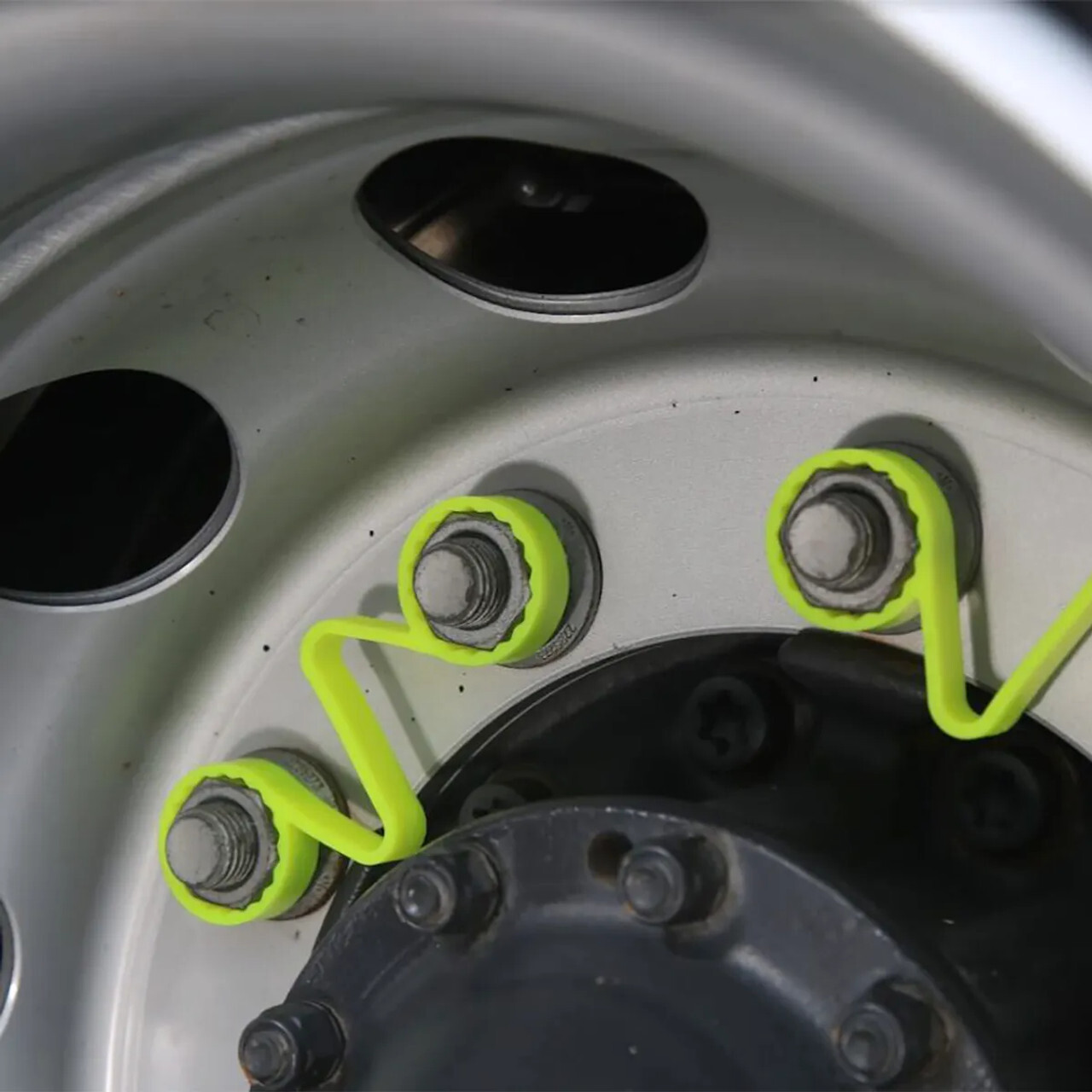
A loose wheel nut indicator is a small polymer pointer that presses onto a wheel nut and turns a torque problem into something a driver can catch on a walkaround. Fit them point-to-point around the hub and the nuts read as a pattern; when one backs off, its pointer swings out of line and the break is visible from a few feet away. The same part doubles as a heat tell-tale: most melt and slump at a set temperature, flagging a dragging brake or failing bearing before it becomes a wheel-off.
JMC Automotive Equipment stocks 62 products here from three manufacturers: Checkpoint (53 items), AME International (8) and ESCO (1). Fifty-nine are wheel nut indicators; the other three are a chamfer gauge and two removal tools. Between them they cover 23 nut sizes from 17 mm (11/16 in.) up to 46 mm (1 13/16 in.), in four colors, in arrow, dust-cap, retaining-link and retaining-ring styles, all new and sold by the bag. Lug nut indicators, wheel nut markers, wheel nut arrows and wheel nut alignment markers all name this same family of parts.
▸ Read the full Wheel Nut Indicators buying guide — types, capacity, power and space, comparison table and FAQs
Start with the nut size, not the model
These indicators are sized to the hex of the wheel nut, measured across the flats. A 33 mm indicator will not stay on a 32 mm nut and will not go onto a 35 mm nut at all. Measure before ordering, and check that every position uses the same nut, because mixed hardware after a hub rebuild is common.
The 21 mm (13/16 in.) size is carried across five products, so the size does not decide the style for you: CPY21 (Checkpoint arrow, yellow), CTR21 (Checktorque, red), CLY21 (Checklink indicator and retainer), DTLRY21 (Dustite Long Reach indicator and dust cap) and AME-62421 (AME CheckMate, high-visibility yellow). The 33 mm (1 5/16 in.) size is the deepest of all: it is the one size offered in every style here, including both Luglock rings and both Medium Arrows, which exist in no other size. The only exception is the AME CheckMate, where 33 mm is offered in the high-temperature version (62400H) but not in the standard one.
Sizes carried in this category
Checkpoint standard arrows cover the widest span on their own: 17, 19, 20, 21, 22, 23, 24, 25, 26, 27, 28, 30, 31, 32, 33, 35, 36, 38, 40, 41, 44, 45 and 46 mm, each listing showing its inch equivalent. The other styles cover a narrower band:
- Checktorque (red): 19, 21, 22, 33 and 38 mm.
- Checkpoint high temperature (orange): 27, 32, 33 and 38 mm.
- Checklink (indicator and retainer): 21, 22, 32, 33 and 38 mm in yellow; 32 and 33 mm in silver grey.
- Dustite (indicator and dust cap): 30 and 33 mm.
- Dustite Long Reach: 19, 21, 22 and 33 mm in yellow; 33 mm in silver grey.
- Luglock (retaining ring and cap): 33 mm, yellow or silver grey.
- AME CheckMate: 19, 21, 30, 32, 38 and 41 mm standard; 33 and 38 mm in the high-temperature version.
The styles, and what changes between them
Checkpoint arrow (the original)
A single-nut pointer with a long tail. Placed point to point, any movement of the nut is clearly visible at a glance. It does not hold the nut; it only reports. Bags of 100. Yellow is the volume color (CPY17 through CPY46); CPSG33 is the same part in silver grey.
Checkpoint Medium Arrow
Same body, shortened arrow. Checkpoint states this version is designed for 10-stud wheels with 285 pitch circle diameters (PCDs); the listing does not give the unit. Stocked in 33 mm only: CPMASY33 in solid yellow, CPMAO33HT in orange.
Checktorque
The Checkpoint pointer in red. Its listed specification matches the standard arrow, melt point included; the difference is the color, which lets you code positions or checks apart from the yellow used elsewhere. Bags of 100, in 19, 21, 22, 33 and 38 mm.
Dustite and Dustite Long Reach
These combine the indicator with a protective cap that closes over the nut, keeping out water, dirt, road salt and rust build-up. The distinction between the two matters at fitting time: the standard Dustite (DTY30, DTY33) is specified for wheels without trims and step rings, and the Long Reach version (DTLRY19, DTLRY21, DTLRY22, DTLRY33, DTLRSG33) has a longer barrel specifically for wheels that do have trims or step rings. Both come in bags of 50. The cap grips the nut, so removal by hand is slow; the Checkpoint DTRT Dustite Removal Tool is a non-slip plier made for the job, rated on its listing for Dustite and Dustite LR from 24 to 41 mm (0.9 to 1.61 in.). The 19, 21 and 22 mm Dustite LR sizes fall below that stated range, so plan on removing those by hand.
Checklink
An S-shaped link spanning two adjacent nuts instead of sitting on one. That geometry adds a retaining function: the polymer resists the nut turning, and if it moves anyway, the S distorts visibly. Bags of 50, in 21, 22, 32, 33 and 38 mm yellow plus 32 and 33 mm silver grey.
Luglock
A one-piece retaining ring with an integrated protective cap covering the whole nut circle. Checkpoint states it is designed for the North American market, for 22.5 in. wheels with a 285.75 mm pitch circle diameter, and for wheels without trims or step rings. It is durable and reusable rather than a consumable, which is why it ships in bags of 2: LLY331028575 in yellow, LLSG331028575 in silver grey. The matching LLRL Luglock Removal Lever pries the ring off without damaging an alloy wheel.
AME CheckMate
AME International's take on the single-nut indicator, molded in polyurethane rather than Checkpoint's polymer, sold in bags of 100. Standard models come in high-visibility yellow (62419, 62421, 62430, 62432, 62438, 62441), the high-temperature models in orange (62400H at 33 mm, 62438H at 38 mm). The AME listings state material and pack quantity but publish no melt temperature, so if that threshold is part of your spec, ask for the model flyer before a fleet-wide rollout.
Melt temperature: the spec buyers miss
Every Checkpoint indicator here except the Luglock is described as melting at a specific temperature so a hot wheel gives itself away; the Luglock listing states no melt temperature. There are two thresholds in this category, and they are not interchangeable:
- 125 C (257 F) - the standard threshold. It applies to the Checkpoint yellow and silver grey arrows, both Medium Arrows, Checktorque, Checklink, Dustite and Dustite LR.
- 165 C (329 F) - the high-temperature orange Checkpoint arrows: CPO27HT, CPO32HT, CPO33HT and CPO38HT.
Choose the higher threshold where normal operation already runs hot enough to slump a standard indicator, the usual complaint on heavy haul, steep-grade and stop-start municipal work. On ordinary line-haul, 125 C gives an earlier warning and is the sensible default.
One inconsistency worth flagging: the CPMAO33HT listing is named as a high-temperature Medium Arrow, but its body text and feature list both state 125 C (257 F), the standard threshold, rather than the 165 C (329 F) quoted for the CPO high-temperature arrows. The product name and the orange color point to a high-temperature part. If that threshold is why you are buying it, confirm the figure against the model flyer before ordering.
Fitting and material
Fit them after the nuts are torqued to the vehicle manufacturer's specification, orient every pointer the same way, and record the pattern so the next inspection has a reference. An indicator does not replace a torque wrench and does not retorque anything.
Checkpoint gives the material for its indicators as high-grade virgin polymer, chosen for reliable overheating indication. AME CheckMate indicators are polyurethane. Both are consumables in normal use; the Luglock ring and the two hand tools are the reusable items here.
Pack quantity drives your line cost, so compare like with like. Checkpoint arrows, Checktorque, Medium Arrow, the high-temperature orange arrows and every AME CheckMate come in bags of 100; Checklink, Dustite and Dustite LR in bags of 50; Luglock in bags of 2.
Standards and compliance statements
These are inspection aids, not load-bearing hardware, so the certifications that matter on a lift or a jack stand do not apply. What the listings declare:
- ASTM D5511. Checkpoint products contain a bio additive validated by independent ASTM D5511 testing for enhanced biodegradation in landfill conditions.
- Fleet safety bodies. Checkpoint's literature positions the products as supporting roadworthiness commitments to bodies including DfT, FORS, DVSA, HSE, FTA and RHA. Those are United Kingdom organizations; in North America, treat the indicators as support for your own documented walkaround and torque-check procedure, not a substitute for it.
- California Proposition 65. The ESCO 60929 Wheel Nut/Chamfer Gauge carries a Prop 65 warning on its listing.
Checking the nut seat, not just the nut
An indicator tells you a nut moved, not why. When nuts on one hub keep backing off, worn bolt-hole chamfers are a common culprit, and the ESCO 60929 Wheel Nut/Chamfer Gauge here is the tool for that check. It is a disc wheel measuring kit that gives a visual guide to excessive wear in the .875R spherical chamfers of bolt holes, and shows when wheel and inner or outer cap nuts are worn out. ESCO specifies it for stud-piloted steel wheels with .875 spherical bolt holes and 3/8 in. to 1/2 in. disc thickness, and states it is for stud-piloted steel wheels only.
Model comparison
| Model | Type | Size | Color | Melt point | Pack | Notes |
| CPY21 | Checkpoint arrow | 21 mm (13/16 in.) | Yellow | 125 C / 257 F | 100 | Indicates only |
| CPY33 | Checkpoint arrow | 33 mm (1 5/16 in.) | Yellow | 125 C / 257 F | 100 | Most widely stocked size |
| CPSG33 | Checkpoint arrow | 33 mm (1 5/16 in.) | Silver grey | 125 C / 257 F | 100 | Low-visibility finish |
| CPO33HT | Checkpoint high temperature | 33 mm (1 5/16 in.) | Orange | 165 C / 329 F | 100 | For hot-running duty |
| CPMASY33 | Medium Arrow | 33 mm (1 5/16 in.) | Solid yellow | 125 C / 257 F | 100 | 10-stud wheels, 285 PCD |
| CTR21 | Checktorque | 21 mm (13/16 in.) | Red | 125 C / 257 F | 100 | Color-coded second check |
| CLY33 | Checklink | 33 mm (1 5/16 in.) | Yellow | 125 C / 257 F | 50 | Spans two adjacent nuts; retains |
| DTY33 | Dustite | 33 mm (1 5/16 in.) | Yellow | 125 C / 257 F | 50 | Wheels without trims or step rings |
| DTLRY21 | Dustite Long Reach | 21 mm (13/16 in.) | Yellow | 125 C / 257 F | 50 | Wheels with trims or step rings |
| LLY331028575 | Luglock | 33 mm (1 5/16 in.) | Yellow | Not stated on listing | 2 | 22.5 in. wheels, 285.75 mm PCD; reusable |
| AME-62421 | AME CheckMate | 21 mm | High-vis yellow | Not stated on listing | 100 | Polyurethane |
| AME-62400H | AME CheckMate high temp | 33 mm | Orange | Not stated on listing | 100 | Polyurethane |
Frequently asked questions
What size wheel nut indicator do I need?
Measure the wheel nut across the flats; that figure in millimeters is the indicator size. This category covers 23 sizes from 17 mm (11/16 in.) to 46 mm (1 13/16 in.); 33 mm is carried across the most styles, followed by 21 mm and 38 mm. If your nut measures a size you do not see listed, contact us before substituting a neighboring size: these are friction-fit parts, and a loose indicator is worse than none.
Do wheel nut indicators keep the nut from loosening?
Most do not, and it is worth being clear about that. The Checkpoint arrow, Checktorque, Medium Arrow, Dustite and AME CheckMate report movement but do not resist it. Two products here add a retaining function: Checklink, which connects two adjacent nuts with an S-shaped polymer link, and Luglock, a one-piece ring that helps retain the nuts across the whole wheel. Neither replaces correct torque.
What is the difference between the standard and high-temperature versions?
The melt threshold. Standard Checkpoint parts are specified to melt at 125 C (257 F); the orange CPO27HT, CPO32HT, CPO33HT and CPO38HT at 165 C (329 F). If your wheel ends routinely run hot enough to distort standard indicators, the high-temperature version stops the nuisance melting without giving up the heat warning.
Which one do I use on wheels with trims or step rings?
The Dustite Long Reach, which has a longer barrel made for exactly that. Both the standard Dustite and Luglock are specified for wheels without trims and step rings. The two are not interchangeable, so confirm whether the wheel has trims or step rings before ordering.
How are they priced and packaged?
By the bag, not by the piece. Checkpoint arrows, Checktorque, Medium Arrow, high-temperature orange arrows and AME CheckMate ship in bags of 100; Checklink, Dustite and Dustite LR in bags of 50; Luglock in bags of 2, being a reusable ring rather than a consumable. Each listing shows its current price for the full bag, so per-indicator cost is that price divided by the pack quantity.
Can I reuse them after a wheel service?
Treat the arrow-style indicators as consumables and fit new ones after any wheel removal or retorque: the whole point of the pattern is that it was set at a known-good torque. The Luglock ring is described as durable and reusable, as are the two hand tools here, the DTRT Dustite Removal Tool and the LLRL Luglock Removal Lever.
For help matching a size, melt threshold or style to your fleet, order online or call 800-562-4791.


 CALL US NOW
