
Paint Booth Requirements & Regulations: A Complete Compliance Guide
Posted by JMC Team on 23rd Jul 2026
A paint booth isn't just a box with a fan in it. It's a piece of safety equipment, regulated by multiple federal agencies, because the materials sprayed inside it are flammable, the vapors can be hazardous to breathe, and the overspray has to go somewhere that doesn't harm the environment.
Get the compliance wrong, and you're not just risking a fine. You're risking a fire, a worker's lungs, or both.
Three federal bodies govern paint booth requirements in the United States: OSHA, NFPA, and the EPA. Each one cares about a different piece of the puzzle.
Read on to find out what each requires, in plain language, so you know what to check before an inspector does it for you.
Overview of the Regulatory Bodies
OSHA
OSHA regulates workplace safety. Its core standard for paint booths, 29 CFR 1910.107, covers spray finishing using flammable and combustible materials, and it dictates booth construction, ventilation, electrical classification, and fire protection for general industry settings, the category most automotive paint booths fall under.
A related standard, 1926.66, covers spray booth construction specifically in construction-industry work. OSHA enforces these standards directly, and citations carry real financial weight. Penalties for serious violations run into the tens of thousands of dollars per violation, adjusted annually for inflation, with willful or repeated violations costing substantially more.
NFPA
The National Fire Protection Association publishes NFPA 33, the Standard for Spray Application Using Flammable or Combustible Materials. NFPA 33 is a consensus standard, not a federal law on its own, but it's the document most fire marshals, building inspectors, and insurance companies point to when evaluating a booth's fire safety.
It's revised on a regular cycle, so the specific edition referenced by your local authority having jurisdiction (AHJ) can vary by location and by how recently your jurisdiction has updated its adopted codes.
EPA
The EPA regulates what comes out of the booth into the air. For auto body and collision repair shops specifically, the relevant rule is NESHAP 6H, officially the National Emission Standards for Hazardous Air Pollutants for Paint Stripping and Miscellaneous Surface Coating Operations at Area Sources.
It governs filtration efficiency, spray equipment type, and painter training, with the goal of limiting hazardous air pollutants released during refinishing work.
A fourth body worth knowing about: many states and municipalities also enforce the International Fire Code (IFC), which addresses paint booths in its own chapter and closely mirrors NFPA 33. Whichever set of codes is stricter in your jurisdiction is generally the one you have to follow.
OSHA Paint Booth Requirements
General Safety and Construction
OSHA sets clear baseline requirements for how a spray booth itself has to be built:
- Substantially constructed of steel, securely and rigidly supported, or built from concrete or masonry
- Aluminum or other noncombustible materials permitted only for intermittent or low-volume spraying
- Interior surfaces smooth and continuous, without edges or pockets where residue can accumulate
- A clear space of at least 3 feet maintained on all sides, kept free of storage or combustible construction
These requirements serve two purposes: reducing fire risk and making the booth easier to clean and maintain over time.
Ventilation and Airflow
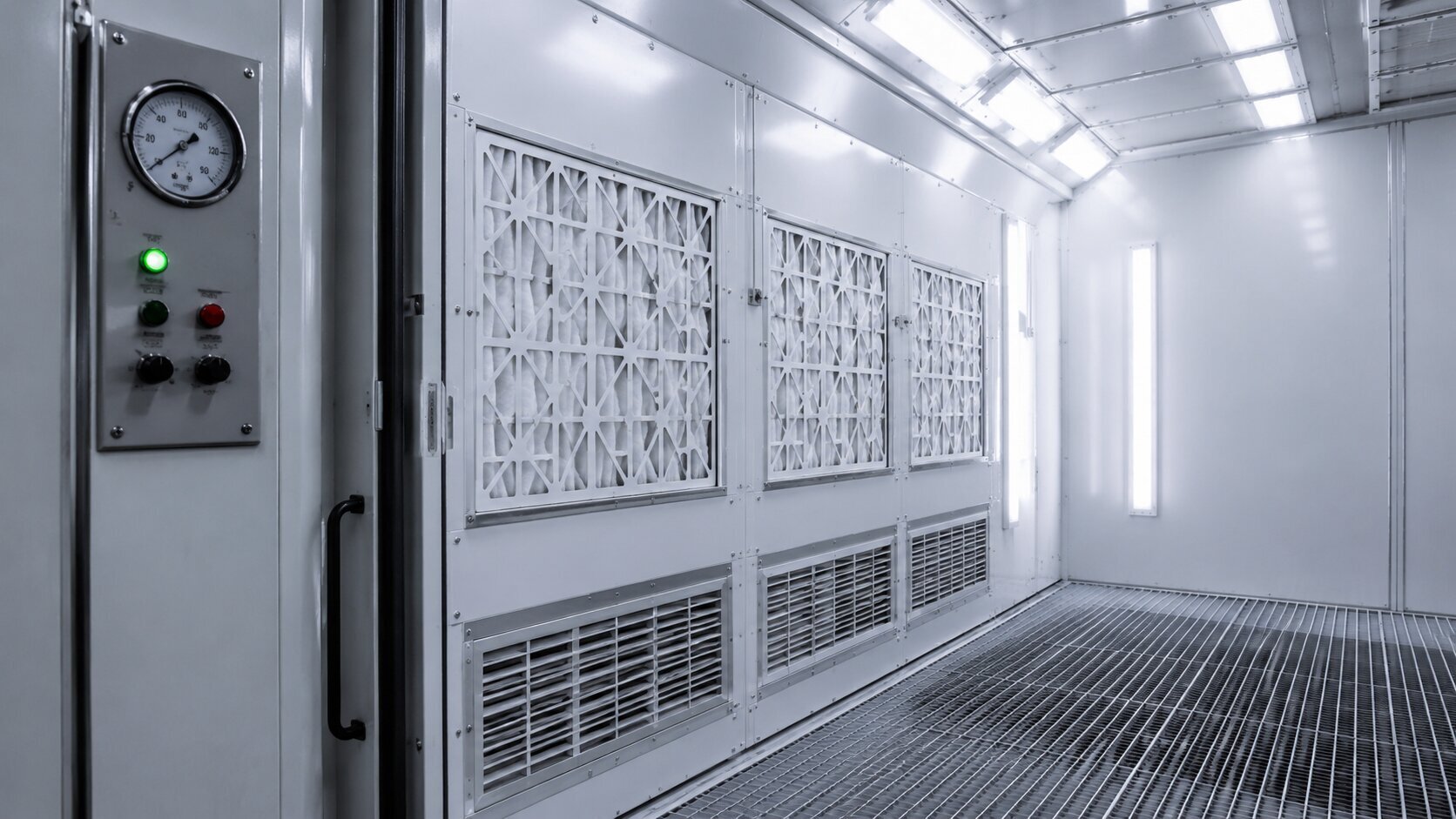
Ventilation is the backbone of OSHA's spray booth standard, since it addresses two separate hazards at once: keeping flammable vapor concentrations low enough to prevent fire or explosion, and keeping worker exposure to toxic vapors within safe limits.
The standard requires an average air velocity across the open face of the booth of at least 100 linear feet per minute during conventional spraying. This is part of why open face paint booths remain a popular configuration for smaller shops; the open design simplifies meeting that airflow requirement compared to a fully enclosed structure.
Electrostatic spraying operations can run as low as 60 linear feet per minute, since the process itself reduces overspray. Ventilation has to stay running for a sufficient time after spraying stops, long enough to clear vapors from coated surfaces and finishing material residue, not just shut off the moment the gun stops firing.
Worker Protection and Electrical Safety
Because spray booths handle flammable vapors, several distinct safety systems work together to protect workers:
- The booth interior is classified as a hazardous location under the National Electrical Code, with electrical equipment rated accordingly
- The area immediately outside booth openings carries a similar, slightly less stringent classification
- Lighting viewed through glass or transparent panels must use fixed units, isolated from the spray area, with panels designed so that residue buildup won't reach a dangerous temperature from the light source
- Approved automatic sprinklers are generally required on both sides of the filters, though a dry chemical or carbon dioxide system can substitute if it meets OSHA's requirements
Airflow gauges, filter media, and fire extinguishers all fall under routine paint booth accessories, worth keeping stocked since several of these requirements depend on equipment staying in working order.
NFPA 33 Standards
Fire Prevention
NFPA 33 exists to reduce the risk of fire and explosion during spray application of flammable or combustible materials. It requires spray application to be confined to a spray booth, spray room, or defined spray area, and it sets housekeeping requirements aimed at preventing combustible residue from building up to dangerous levels.
Like OSHA, it calls for a minimum 3-foot clear space on all sides and above the booth, with narrow exceptions for booths positioned against fire-rated walls.
Electrical Requirements
NFPA 33 leans heavily on NFPA 70, the National Electrical Code, specifically Article 516, which governs spray application, dipping, and coating processes. This is where hazardous location classifications for wiring, fixtures, and equipment near a spray booth get their technical detail.
NFPA 33 also interacts with related standards covering exhaust duct systems and fire extinguishing systems, so a fully compliant installation usually touches several NFPA documents at once, not just one.
Booth Construction Materials
Where NFPA 33 differs in practice from a literal reading of the OSHA standard is in the use of aluminum. OSHA's language permits aluminum for intermittent or low-volume spraying. Versions of the fire code built on NFPA 33, however, often specify approved noncombustible materials and exclude aluminum outright.
This is a good example of why checking your local AHJ matters: two standards that are both technically in play can land in slightly different places, and the stricter one generally wins.
EPA Regulations
Emissions and VOCs
Auto body and collision repair shops fall under NESHAP 6H, a rule that's been in effect since 2008. It applies to any shop spray-applying coatings to motor vehicles or mobile equipment, and to any shop using methylene chloride-based paint strippers. Larger operations spraying mobile equipment, parts, or assemblies beyond passenger vehicles often fall under this rule too, which is one reason industrial paint booths are built with the same filtration and ventilation standards in mind from the start.
Under 6H, the core requirements are:
- Spray booths refinishing complete vehicles must be fully enclosed and ventilated, generally at negative pressure
- Booths with sealed doors and an automatic pressure balancing system may run at a slight positive pressure instead
- Filters must achieve at least 98 percent collection efficiency for paint overspray
- Spray guns must be HVLP, electrostatic, airless, air-assisted airless, or an equivalent low-emission technology, rather than older conventional guns that waste more material as overspray
Environmental and Training Considerations
A notable exception under 6H: spray applications using less than 3 fluid ounces of material in a single application don't have to take place inside a spray booth at all. Beyond that threshold, a few other obligations kick in:
- Painters must be trained in spray equipment selection, technique, and environmental compliance
- Refresher training is required every five years, with documentation kept on file
- Shops not using coatings containing the five regulated metal HAPs (chromium, lead, manganese, nickel, or cadmium) can petition for an exemption, a process that was simplified in 2023
- Some states layer additional VOC limits on top of the federal rule, so check state-level requirements alongside the federal ones, particularly in states with their own air quality programs
Key Paint Booth Requirements at a Glance
Local requirements can be more restrictive than any of the federal baselines above, so this table is a starting point for the conversation with your AHJ, not a substitute for it.
Compliance Checklist for Shop Owners
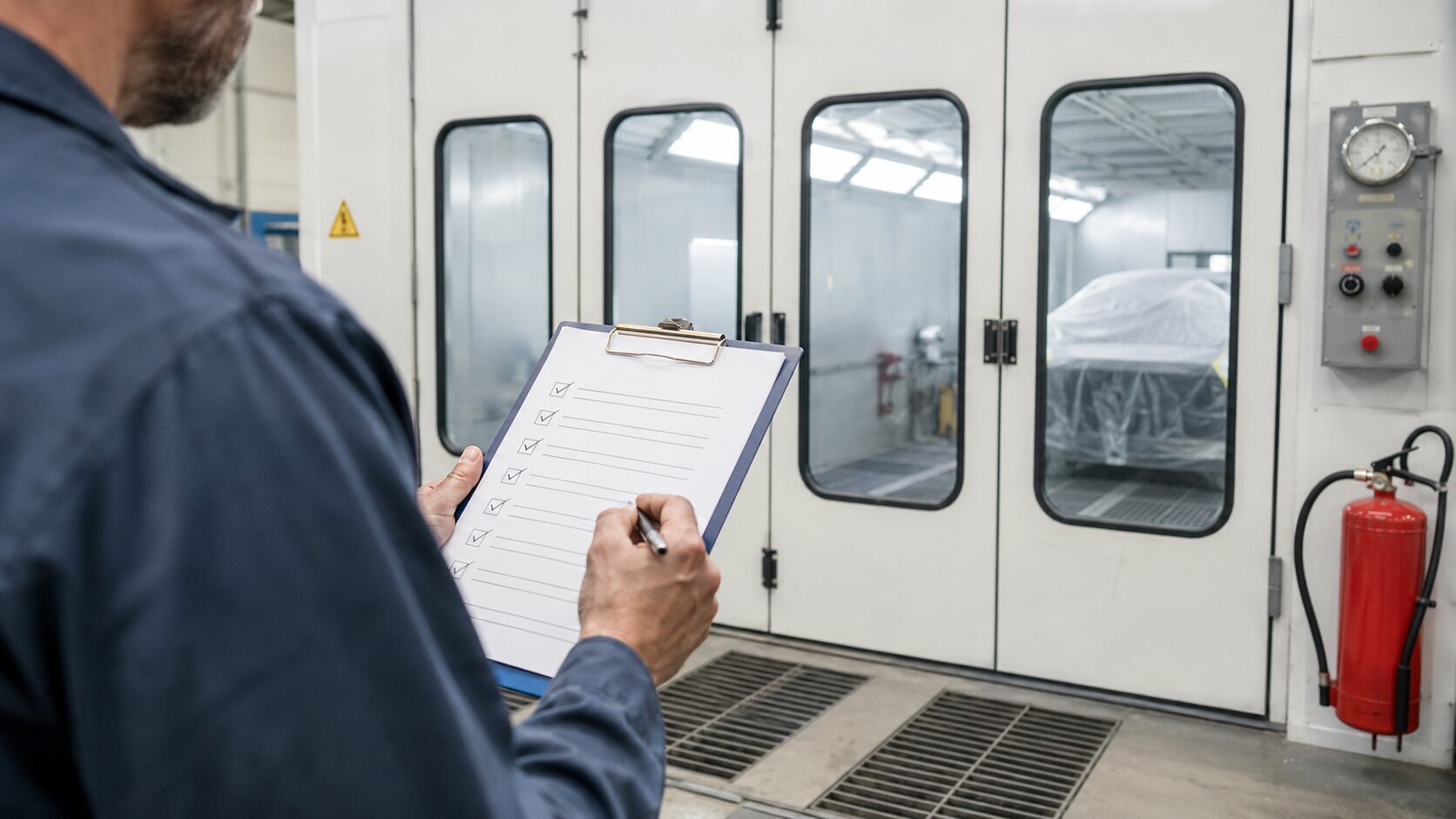
☐ Booth is constructed of steel, concrete, or masonry, with no unapproved combustible materials
☐ Interior surfaces are smooth, continuous, and free of pockets where residue collects
☐ A minimum 3-foot clear space is maintained on all sides and above the booth
☐ Airflow is verified at 100 fpm (60 fpm for electrostatic) and documented, with a working gauge installed
☐ Exhaust discharges to a safe outdoor location, not into an attic, crawl space, or mechanical room
☐ Filters are rated for the required collection efficiency and inspected on a regular schedule
☐ Electrical equipment in and around the booth meets hazardous location requirements
☐ Automatic sprinklers or an approved alternative fire suppression system are installed and tested
☐ Portable fire extinguishers are stocked near the spraying area
☐ Spray guns in use are HVLP, electrostatic, airless, or an equivalent low-emission type
☐ Painter training records are current and kept on file
☐ Local fire marshal and EPA permitting requirements have been confirmed for your specific jurisdiction
Buy a Booth Built for Compliance
Meeting every requirement above starts with equipment that's built to the right specifications from the factory. Browse the full paint booth collection at JMC Equipment, or call 800-562-4791 to talk through what your shop needs.
And before any installation, confirm the specifics with your local fire marshal and environmental agency. This guide is a starting point, not a substitute for sign-off from your AHJ.
Frequently Asked Questions
Do all paint booths need fire suppression?
Most do. OSHA generally requires automatic sprinklers on both the upstream and downstream sides of the booth's filters, though an approved dry chemical or carbon dioxide system can be used instead if it meets the same protection standard. Whether your specific booth needs full sprinkler coverage throughout, not just at the filters, depends on factors such as whether the building itself is sprinklered and what type of spray equipment is in use. This is exactly the kind of detail to confirm with your local fire marshal before installation.
What are OSHA's ventilation standards?
The average air velocity across the open face of the booth must be at least 100 linear feet per minute during conventional spraying, or 60 linear feet per minute for electrostatic spraying. Ventilation must run throughout spraying and continue afterward long enough to clear vapors and residue. A working airflow gauge should be installed and checked regularly, since inspectors typically check this first.
What height and space are required for a paint booth?
There's no single federal number that applies to every booth, since required clearance depends on the specific booth's dimensions, its ventilation design, and your local fire code. What is consistent across OSHA and NFPA 33 is the minimum 3-foot clear space required on all sides and above the booth, kept free of storage and combustible materials. Beyond that, check the manufacturer's specifications for your specific model and confirm ceiling height and footprint with your local building department before installation.
Does NFPA 33 apply to every spray operation?
Not necessarily. Small-scale operations using minimal quantities of material, or operations using non-flammable coatings, may fall outside NFPA 33's scope. Outdoor spraying is generally exempt, too, since overspray buildup indoors is the primary fire concern the standard addresses. That said, OSHA's own standards can still apply even when NFPA 33 doesn't, so one exemption doesn't automatically mean you're clear of all federal requirements.
Who enforces these requirements, and who do I actually call?
OSHA enforces its own standards directly or through a state agency if you're in a state with an OSHA-approved state plan. NFPA 33 itself isn't directly enforced by OSHA, but it's commonly adopted and enforced by local fire marshals, building inspectors, and insurance underwriters. The EPA enforces NESHAP 6H, often through state environmental agencies. Practically speaking, your local fire marshal and your state's environmental agency are the two calls worth making before you install or significantly modify a booth.
Official Resources
This guide summarizes the requirements in plain language, but the regulations themselves are the final word. Direct links to each source:
- OSHA 29 CFR 1910.107 — Spray Finishing Using Flammable and Combustible Materials
- NFPA 33 — Standard for Spray Application Using Flammable or Combustible Materials
- EPA NESHAP 6H (40 CFR Part 63, Subpart HHHHHH) — Paint Stripping and Miscellaneous Surface Coating Operations
 CALL US NOW
