
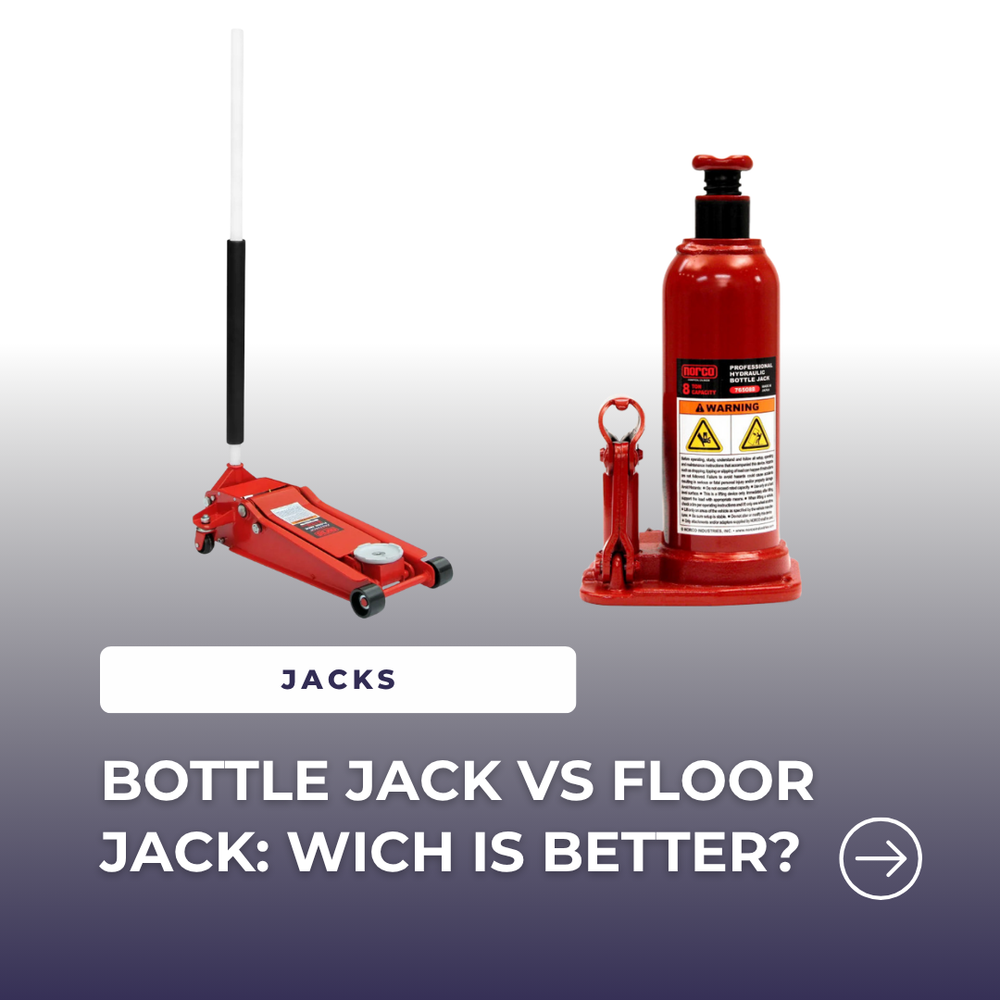
Bottle Jack vs Floor Jack: Which One Should You Buy?
23rd May 2025
If you're looking for a hydraulic jack to lift your vehicle, you've almost certainly run into the same old debate: bottle jack or floor jack.
Both of them lift, both are hydraulic, and both show up with similar capacities. The real difference is in the shape, and everything else follows from the shape.
A bottle jack is a vertical cylinder that pushes straight up. A floor jack is a flat trolley on wheels, with an arm that rises in an arc. That single difference in geometry decides how much each one weighs, how far under the car it can go, how high it reaches, and which vehicles you'll be able to use it on.
This guide compares the two with the measurements of each, and closes with a concrete recommendation for each case.
Why is it important to choose the right jack?
Choosing the right jack isn't only a matter of convenience. A jack that doesn't suit your vehicle may not fit underneath it, may run out of travel before it gives you room to work, or may force you to place it on a point that wasn't built to carry weight.
There's also a less dramatic but equally real cost: the wrong jack turns a twenty-minute job into a whole afternoon. More effort, more pumping, more times you have to lower it and reposition.
That's why it's worth comparing with figures rather than impressions. Let's take it in parts.
Bottle jack vs floor jack: the comparison
Design and portability
This is the difference you feel most, and there's a very clear number behind it.
A three-ton bottle jack weighs eight pounds. A three-ton floor jack weighs between seventy-seven and a hundred and six.
The same load capacity, and a tenfold difference in weight. The reason is that a bottle jack is only the cylinder, while a floor jack also carries the chassis, the four wheels, the arm and the handle.
That decides where each one lives. The bottle jack fits in the trunk and travels with you to wherever the car breaks down. The floor jack stays in the garage or the shop, because nobody carries a hundred pounds out onto the highway.
If what you need is something for roadside emergencies, the comparison ends here and the answer is the bottle jack.
Load capacity and power
Here it's worth stating something that often gets said backwards.
At equal physical size, the bottle jack carries more. Its cylindrical design concentrates a great deal of force in a small body, which is why there are twenty-ton bottle jacks that weigh forty pounds and fit in two hands.
But at equal capacity, the floor jack delivers more. A three-ton floor jack and a three-ton bottle jack lift the same weight; what changes is where they start and where they finish, which is what the next section is about.
And there's one detail about bottle jacks worth knowing before you buy: the more capacity it has, the higher it starts. The two-ton begins at 7.125 inches, the five-ton at 9.06, the twenty-ton at 10.875. More capacity calls for a thicker cylinder and a wider base, and that lifts the whole body of the jack.
Minimum height and reach
This is the section that decides the purchase, and it's the one to look at if the jack is going to live in your garage.
Minimum height is how tall the jack is when it's all the way down, and it's what has to fit in the clearance under your vehicle.
| Bottle jack | Capacity | Starts at | Reaches | Weight |
|---|---|---|---|---|
| Norco 2-ton | 2 tons | 7.125" | 14.5" | 6 lbs |
| Norco 3-ton | 3 tons | 7.5" | 15.56" | 8 lbs |
| Norco 5-ton | 5 tons | 9.06" | 18.875" | 11.5 lbs |
| Norco 8-ton | 8 tons | 9.06" | 18.75" | 14 lbs |
| Norco 20-ton, air | 20 tons | 10.875" | 20.5" | 41 lbs |
| Floor jack | Capacity | Starts at | Reaches | Weight |
|---|---|---|---|---|
| Ranger Low Rider, long frame | 3,000 lbs | 2.75" | 24" | 106 lbs |
| Norco 3-ton | 3 tons | 3" | 19.75" | 73–77 lbs |
| Norco 3.5-ton | 3.5 tons | 4" | 21.375" | 106 lbs |
| Ranger RFJ-3T | 6,000 lbs | 4.75" | 20.5" | 98 lbs |
| Ranger 3-ton Professional | 6,000 lbs | 5.25" | 19.25" | 84 lbs |
An ordinary sedan has between five and seven inches of ground clearance. With that figure alongside, the table turns into a decision: a conventional three-ton bottle jack starts at 7.5 inches and does not fit under a sedan. It isn't a tight fit. It doesn't fit.
There is one family that gets around the minimum height, and it comes with a limit of its own. Mini bottle jacks are built deliberately low: the five-ton Zinko ZMJ-5C starts at 2.36 inches and the twenty-ton ZMJ-20 at 5.12, both well under a sedan. What they give up is travel. The ZMJ-5C rises 0.78 of an inch and the ZMJ-20 rises 1.18, so they are made for centering heavy equipment, spreading, and fine adjustment in tight spaces — not for raising a car far enough to take a wheel off. For that job, the rule above still holds.
That's why bottle jacks get associated with pickups and SUVs. The reason isn't that they lift more, it's that only tall vehicles have the room to slide one underneath.
And the floor jack doesn't fall short up top either, which is what you'd expect from something that starts so low. The three-ton bottle jack finishes at 15.56 inches; the floor jack of the same capacity reaches 19.75. Ranger's Low Rider, the one that goes lowest of all, is also the one that goes highest: twenty-four inches.
The explanation is in the travel. The cylinder on a three-ton bottle jack has a stroke of five and a quarter inches, and that's all it can push. The arm on a floor jack sweeps a long arc and covers far more distance with the same pump.
Now, if your case is heavy weight and little clearance, there's a way out: the "low height" models. Norco's twelve-and-a-half-ton in its low version starts at 6.69 inches, lower than the standard five-ton, and still lifts twelve and a half tons. Browse the bottle jacks available.
Accuracy and control
With the measurements clear, what's left is how the two feel to work with.
A bottle jack rises quickly, but with less fine control. Its base is small — four by four and a half inches on the three-ton — and that makes it less stable on uneven ground.
A floor jack offers more stability and more control. It rolls to the exact spot, and the arc of the arm rises more gradually, which helps when you're adjusting the vehicle's position. That's what makes the difference on repetitive work and on low cars. Browse the floor jacks available.
Which jacks do we recommend?
With all of the above on the table, these are the two concrete options for the two most common cases.
For pickups, vans and heavy-duty work: the Norco 8-ton bottle jack. It lifts eight tons, weighs fourteen pounds and comes with a carry handle. It starts at 9.06 inches and reaches 18.75, so it needs a vehicle with good ground clearance. It fits in the trunk and travels with you.
For street cars and garage work: the Norco 3-ton floor jack. It starts at three inches — among the lowest there is — and rises to 19.75. It weighs between seventy-three and seventy-seven pounds, so it stays where you put it, and it's the one that fits under a sedan without argument.
If you work on sports cars or anything very low, look at the Ranger Low Rider: it starts at 2.75 inches and reaches twenty-four, on a thirty-four-inch chassis that gets out to central lift points. The rest of the garage jacks are worth a look too.
One warning that applies to both
Neither jack, whatever its capacity, is meant to hold the car up while you work underneath it.
The jack has the travel to lift; stands have the rigidity to hold. Once the vehicle is up, it goes onto jack stands before you get under it. The jack is only there to get it that high.
If you're not sure which one is yours, call us
Three pieces of information and we'll tell you exactly which:
- How much ground clearance your vehicle has, measured at the lift point. That's what rules the bottle jack in or out.
- What the heaviest thing you lift weighs.
- Where the jack is going to live: in the trunk or in the garage.
Write or call JMC Automotive Equipment and we'll tell you which of the two is yours.
 CALL US NOW
