
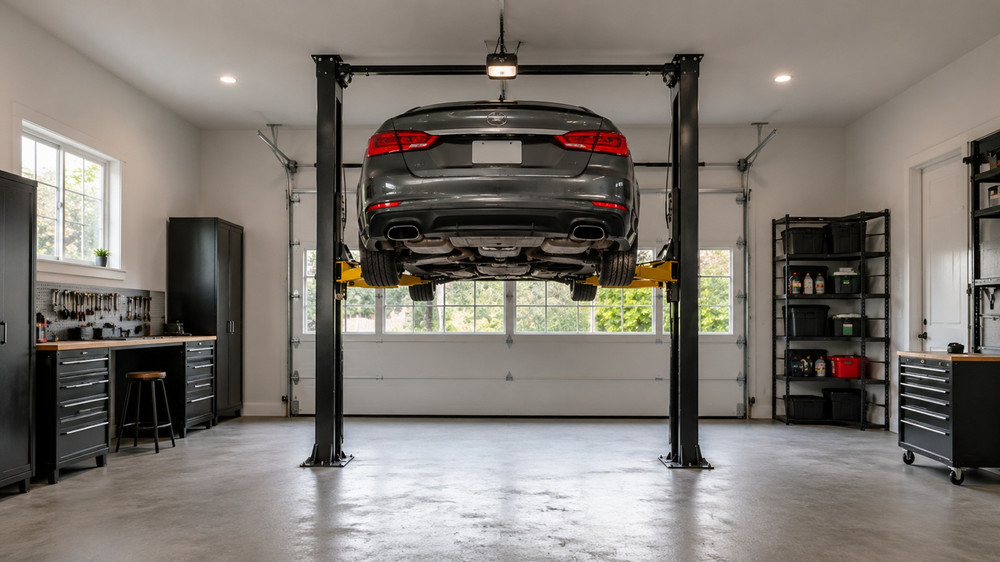
Best Car Lift for Home Garage: How to Choose the Right One
7th Feb 2022
The advice you'll find on a lot of lift sites assumes you're setting up a professional bay. You're not. They'll point you toward 40,000 lb heavy-duty four-posts and inground hydraulic systems, none of which applies to a guy with a two-car garage who wants to do his own brake jobs and stop crawling around on a creeper.
This guide is written for that person.
We'll cover what to measure before you buy anything, which lift types make sense for residential use, and how the main options stack up against each other.
What to Think About Before You Buy a Home Garage Lift
Get this part wrong, and you'll end up with a lift you can't install, can't use, or can't fit through the garage door. These are the four things that actually determine which lift you can buy. Not brand, not price.
Ceiling height. This is the biggest filter. Most two-post and four-post lifts need at least 11–12 feet of clear ceiling height to operate safely. If your garage has a standard 8-foot ceiling, you're looking at low-rise or portable options instead. Measure to the lowest obstruction (joists, lights, door tracks), not just the peak.
Floor thickness and condition. Two-post lifts bolt into the concrete and need a minimum 4-inch slab, though 6 inches is better. If your floor is cracked, uneven, or thin, you'll need to address that before installation. Four-post lifts are less demanding since the load spreads across four points, but the floor still matters. Portable and scissor lifts sit on the surface and don't require anchoring at all.
Available space. A two-post lift needs roughly 10–12 feet of width. A four-post needs more floor footprint, but can double as car storage. Scissor lifts are compact and park flat when not in use. Think about whether you need to walk around the car, open doors, or store other things in the same bay.
Power supply. Most residential lifts run on standard 110V or 220V single-phase power, the same as a dryer outlet. A few heavier commercial models need three-phase power, which most homes don't have. Check before you buy.
Types of Car Lifts for Home Garages
There are five main types worth knowing about for residential use. Each one fits a different garage situation.
2-Post Lifts
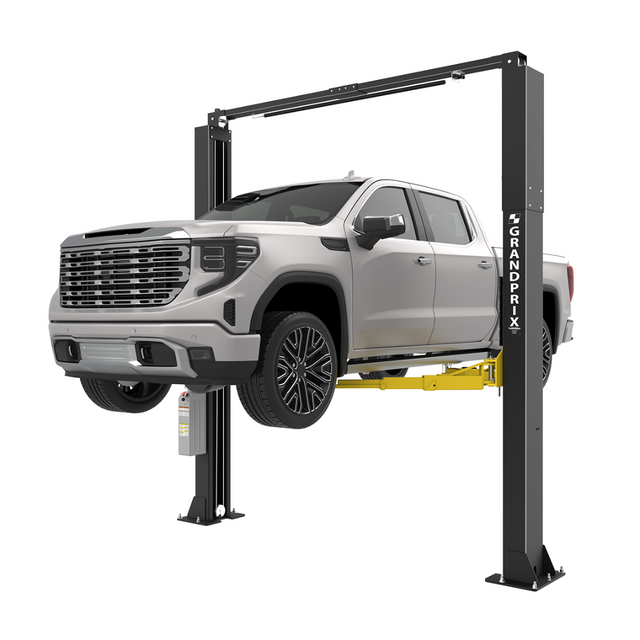
The most popular choice for home mechanics. Two upright columns with four adjustable arms cradle the car at the manufacturer's lift points. Because the wheels hang free in the air, you get full access to suspension, brakes, exhaust, and the entire undercarriage. That's why they're the go-to for actual repair work.
They need ceiling clearance (typically 11–12 feet minimum), a bolted concrete floor, and enough bay width. They also need to be installed properly. This isn't a weekend afternoon job if you've never done it. But once they're in, they're in. Browse JMC's 2-post lift range here.
Best for: Oil changes, brake work, suspension, exhaust, and anything requiring full undercarriage access. Home garages with adequate ceiling height and a solid concrete slab.
4-Post Lifts

Four posts, a drive-on platform, and serious stability. The car drives onto runways and sits supported at the tires, which means you don't get the same underbody access as a two-post without adding a rolling jack. But the stability is unmatched; they don't need to be bolted down in the same way, and they can store a second car underneath.
If you're a car collector or you want to double your parking space as much as you want a work lift, a four-post is worth the extra footprint.
See JMC's 4-post lift options here.
Best for: Car storage, collectors, heavier vehicles, garages where stability matters more than full wheel-off access.
Scissor Lifts

Low-profile when parked, they rise from a flat platform using a scissor mechanism. Great for garages with low ceilings since they don't need vertical column clearance. Just enough height for the car to clear at full rise. You drive onto the platform, and the car goes up.
The tradeoff is access. You're working around the platform, not under an open car. Fine for oil changes and some suspension work, but not ideal for exhaust or anything requiring full undercarriage visibility.
Check out JMC's scissor lift range.
Best for: Low ceiling garages, smaller spaces, lighter maintenance tasks.
Portable / Low-Rise Lifts
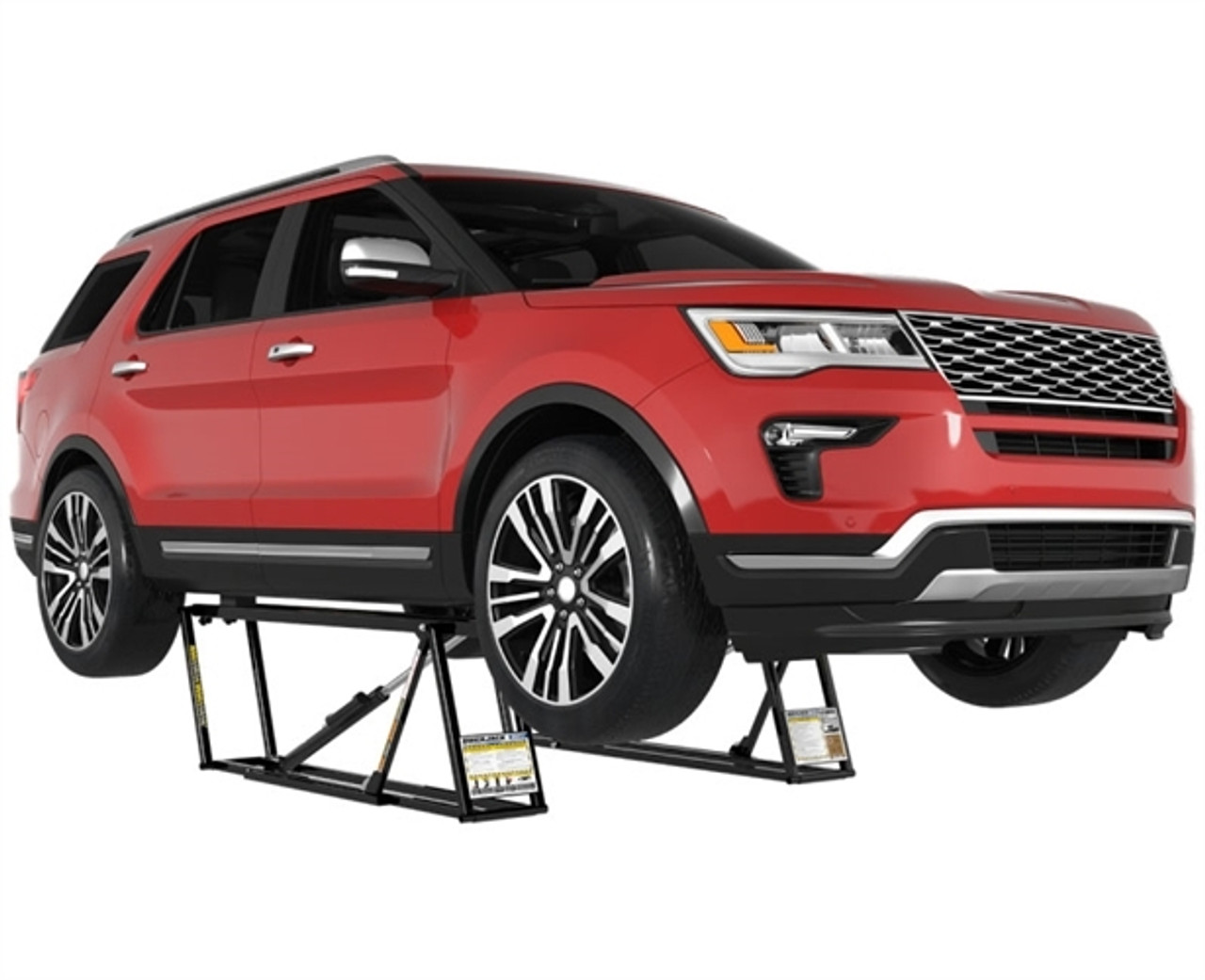
Portable car lifts (sometimes called QuickJacks or drive-on ramps) are hydraulic platforms that slide under the car, lift it off the ground, and stow flat when done. No installation, no ceiling requirements, no bolting to the floor. You can move them, loan them out, or take them to a track day.
The limits are obvious: you won't get professional lift height, they typically max out around 24–28 inches of clearance, and they're not rated for the heaviest trucks. But for anyone looking for low ceiling car lift solutions, they're the most practical answer on the market. Clean, flexible, and works in any garage.
See portable car lift options at JMC.
Best for: Low ceiling garages, renters who can't modify the floor, enthusiasts who want flexibility, and lighter vehicles.
Mid-Rise Lifts

A middle ground between portable and full-height. These freestanding lifts raise the car to about 36–50 inches, enough for a comfortable working height without needing the full ceiling clearance of a two-post. They don't require anchoring and have a smaller footprint than most full-size lifts.
Browse JMC's mid-rise lift range here.
Best for: Wheel and tire work, brakes, and routine service.
How Much Does a Home Garage Car Lift Cost?
Equipment prices vary a lot depending on lift type, capacity, and brand. These are ballpark ranges for residential-grade lifts from reputable manufacturers, not Amazon imports or no-name budget units that won't pass an ALI certification check.
Portable / low-rise lifts: $500–$2,000. QuickJack-style hydraulic systems sit toward the lower end. Heavier-duty portable scissor platforms push closer to two grand. If you're just getting started and want something flexible, this is the lowest-cost entry point.
Mid-rise/scissor lifts: $1,500–$3,500. Price varies with capacity and configuration. A basic drive-on scissor lift for a standard car sits in the lower half of that range. Wider platforms rated for trucks and SUVs cost more.
2-post lifts: $2,500–$6,000. The sweet spot for most home mechanics. A budget-end model gets you a solid, functional lift from a known brand. The upper end gets you BendPak or Challenger with higher capacity, better arm geometry, and longer service life. Don't let the lower end tempt you into buying a lift with no certification credentials.
4-post lifts: $3,500–$8,000+ More steel, more engineering, more money. Standard residential four-posts start around $3,500. Wide-body versions for trucks or dual-car storage push well past $6,000.
The number people forget: installation. The equipment price is only part of the budget. Factor in $500–$1,500 for installation, depending on what your garage needs. Electrical work for a dedicated 220V circuit, concrete anchoring for a two-post, or hiring a professional installer all add up. It's not a dealbreaker; it's just the actual cost. Plan for it upfront rather than getting surprised after the lift arrives.
Prices shift with freight costs, brand, and capacity, so treat these as planning numbers rather than quotes. Always check current pricing directly with JMC before budgeting.
Lift Type Comparison
|
Lift Type |
Ceiling Required |
Floor Anchoring |
Best Use |
Approx. Cost (equipment only) |
|
2-Post |
11–12 ft min |
Yes (bolted) |
Full-service work |
$2,500–$6,000 |
|
4-Post |
11–12 ft min |
Usually not |
Storage + service |
$3,500–$8,000+ |
|
Scissor |
9–10 ft workable |
Usually not |
Light service, low ceilings |
$1,500–$3,500 |
|
Portable/Low-Rise |
Any |
Usually not |
Flexibility, tight spaces |
$500–$2,000 |
|
Mid-Rise |
9–10 ft workable |
Usually not |
Wheel/brake work, comfort |
$1,500–$3,500 |
2-Post vs 4-Post for Home Garages: Which Is Better?

This is the question most homeowners end up asking. The answer depends on what you're actually trying to do.
Choose a 2-post if you're primarily doing maintenance and repairs. The free-hanging wheels are the point. Brakes, suspension, and exhaust work all become dramatically easier when you're not working around a platform. They also take up less floor space since there's no runway between the posts.
Choose a 4-post if storage is part of the equation. Parking one car on top and one underneath is a legitimate reason to buy a four-post. It effectively doubles your garage capacity. They're also easier to drive onto (no precise positioning around lift arms), which matters if others are using the garage. And for heavier trucks and SUVs, the stability can't be beaten.
One thing worth noting: a four-post with a rolling bridge jack gets you much of the wheel-off access of a two-post. It costs more, but it's a legitimate hybrid solution for people who want both storage and service capability.
For most home mechanics focused on working on their own vehicles, the two-post wins on access and footprint. For collectors and anyone who wants to store vehicles vertically, the four-post makes more sense.
Car Lift Safety for Home Use
A lift is only as safe as its installation and its use. A few things that matter more than people often realize:
ALI Certification. Look for lifts certified by the Automotive Lift Institute. ALI certification means the lift has been independently tested against ANSI standards. It's not a guarantee, but it's a meaningful filter. Uncertified budget lifts from unknown manufacturers are where accidents happen.
Concrete matters. Anchoring a two-post lift into inadequate concrete is a genuine safety risk. If you're not sure about your slab, have it assessed before you buy. Most lift manufacturers specify minimum requirements clearly.
Stay within the rated capacity. Every lift has a weight rating. Your vehicle's curb weight plus any tools or fluids inside it counts. Going over rated capacity isn't a small margin-of-error situation. It's how lifts fail.
Safety locks. Any quality lift will have automatic mechanical safety locks that engage as the lift rises. These prevent the car from dropping if hydraulic pressure is lost. Always confirm the locks are engaged before going under the vehicle. Never work under a car held only by hydraulics.
Read the installation instructions. This sounds obvious, but the number of lift failures traced back to improper installation isn’t small. If you're not comfortable with the installation, our team can help point you toward professional installation resources.
Top Car Lift Brands for Home Garages

Brand matters more than most people realize when it comes to car lifts. A cheap uncertified import might look identical to a quality unit on a product page, but the difference shows up in the steel, the safety locks, and the warranty support.
Here's a quick rundown of some of the main brands we carry at JMC and what they're known for.
BendPak is the benchmark. They've been manufacturing lifts since 1965, and every lift they make is ALI certified. Their range covers the full spectrum from portable mid-rise units to heavy-duty four-posts, and they're the brand you'll see in professional shops and serious home garages alike. If budget isn't the primary concern, BendPak is hard to argue against.
Challenger Lifts is another name that comes up in almost every serious comparison. Louisville-based, with decades of manufacturing behind them. Their Versymmetric lift design lets you position arms asymmetrically for better door clearance, which is genuinely useful for home use where you're working around the car rather than just under it. Strong build quality and a loyal following.
JMC Equipment lifts are a practical option for home garage owners who want reliable lifting equipment with direct support from the JMC team. The range includes straightforward two-post and service-focused lift options designed for everyday maintenance, repairs, and general garage use. For buyers who want solid value without moving straight into the premium price tier, JMC Equipment is worth considering.
Tuxedo Lifts are worth knowing about if you want a quality ALI-certified lift at a lower price point than BendPak or Challenger. They don't have the same brand recognition, but the product holds up. JMC has sold a lot of them, and the customer feedback is consistently solid. Good entry point for a first home garage lift.
AMGO Hydraulics rounds out the range, particularly for four-post storage lifts. If you're primarily buying a lift for dual-car storage rather than active repair work, AMGO offers good capacity at reasonable prices.
Choosing Your Lift at JMC
The right lift for your home garage is the one that fits your space, matches your vehicle, and suits what you're actually trying to do with it. Most people fall into one of a few clear categories:
- Tight ceiling, flexible budget → portable or scissor lift
- Good ceiling, repair focus → 2-post
- Good ceiling, storage focus → 4-post
- Want the best of both → 4-post with bridge jack
At JMC Automotive Equipment, we carry a full range of residential car lifts from the brands that actually matter: BendPak, Challenger, and Tuxedo.
If you're not sure which configuration is right for your garage, call the team at 800-562-4791. They know the products, and they'll give you a straight answer.
Frequently Asked Questions
What ceiling height do I need for a car lift?
For a standard two-post or four-post lift, plan for at least 11–12 feet of clearance. Some shorter models work with 10 feet, but check the specs of the specific model before buying. Scissor, mid-rise, and portable lifts can work in garages with 8–9 foot ceilings.
Do I need a permit to install a car lift at home?
In many jurisdictions, yes, especially if you're bolting into the slab or adding electrical circuits. Check with your local building department before starting the project. It's not usually complicated, but skipping permits can cause problems when you sell the house.
What's the minimum concrete thickness for a 2-post lift?
Most manufacturers specify a minimum 4-inch reinforced concrete slab. Thicker is better. Six inches gives a solid margin. The concrete also needs to be in good condition, not cracked or crumbling.
Can I install a car lift myself?
Portable and low-rise lifts, yes. No special tools or skills required. Two-post and four-post lifts can be installed by a capable DIYer, but it takes time, the right tools, and careful attention to the instructions. Many homeowners choose to hire a professional for the anchoring and electrical work.
What's the best car lift for a small garage?
If you're looking for a car lift for a small garage (limited space, low ceiling, or both) a portable lift or mid-rise is usually the answer. Scissor lifts also work well in smaller footprints. If you have the ceiling but limited width, some two-post models are available in narrower configurations.
What's the best car lift for a small garage with low ceilings?
A portable lift is your most practical option under 9 feet. They store flat when not in use, need no installation, and work with any floor. QuickJack-style systems are popular for exactly this reason.
 CALL US NOW
