
Top Five Car Lifts: How to Choose the Best One for Your Auto Repair Shop
Posted by JMC Team on 29th Jun 2023
A bad lift decision in a commercial shop doesn't just cost you the price of the equipment. It costs you in restricted vehicle mix, lost throughput, insurance headaches, and equipment that gets replaced years before it should.
Most lift guides treat this like a consumer purchase. It isn't. You're making a capital equipment decision that affects your revenue per bay, your safety compliance, and what jobs you can actually take on. So let's approach it that way.
This is a guide for shop owners and commercial buyers comparing professional-grade auto shop lift equipment, not a roundup of the prettiest options at the best price point.
We'll cover how to spec a commercial setup, what actually separates professional automotive lifts from consumer-grade alternatives, and which specific models from JMC's catalog make sense for different shop profiles.
Start With Your Shop, Not the Product Page
Auto repair shop owners will often look at lift specs first, but they’ve got it the wrong way round. Before capacity and arm configuration, answer these questions about your operation.
What's on your service menu? General maintenance, brakes, and oil changes need a different primary lift than alignment work or fleet vehicle servicing. Your lift selection should be driven by the work you do and the work you're planning to add. A shop that wants to move into truck servicing needs to account for that before the equipment is bolted to the floor.
How many bays are you running? A three-bay independent and a ten-bay commercial operation have entirely different lift strategies. Most professional shops benefit from a mixed setup: 2-post lifts as the primary service bays, a 4-post handling alignment and storage, and heavy-duty capacity if the vehicle mix calls for it. Buying all the same lift type is rarely the right call.
What vehicles are coming through the door? Passenger cars and light trucks sit in one capacity bracket. Full-size pickups, cargo vans, and fleet vehicles sit in another. Running heavy vehicles regularly on a lift near their rated maximum isn't just an efficiency problem; it's a safety and longevity problem.
What's your slab situation? Permanent lifts need a minimum of 4-inch concrete at 3,000 PSI, properly cured. If you're not certain your floor meets spec, get it checked before you commit to anything floor-mounted. Mobile column lifts are the right answer for shops where the concrete is a question mark.
What does a slow cycle actually cost you? At high volume, a lift that takes 45 seconds longer per vehicle per cycle adds up fast across a full bay day. Arm positioning speed, lock release smoothness, and equalization consistency aren't premium features. They're what separates commercial car lifts from equipment that happens to lift cars.
Get those answers right, and the product decision becomes much simpler.

What Makes a Commercial Car Lift Different
ALI Certification
The Automotive Lift Institute independently tests lifts to ANSI/ALI ALCTV standards, checking that load ratings, safety mechanisms, and construction actually match what the manufacturer claims. For a professional shop, that certification isn't optional.
Most commercial insurance carriers require it, OSHA workplace safety standards reference it under 29 CFR 1910, and if something goes wrong with uncertified equipment, you're exposed in ways that go well beyond the cost of the lift itself.
Every lift in this guide is ALI-certified or carries an equivalent third-party certification.
Commercial Load Cycles vs Consumer Use
A home garage lift might run 50-100 cycles a year. A busy commercial shop bay runs that in a week. Commercial-grade lifts are built to a different standard: heavier-gauge steel, larger bore hydraulic cylinders, self-lubricating bearing systems, and tighter manufacturing tolerances.
The price difference is real. So is the performance gap under sustained daily use. A consumer-grade lift in a commercial shop isn't saving you money; it's deferring a replacement purchase.
Capacity Headroom
Size up. A lift operating at its rated maximum on heavy vehicles every day is running at the edge of its design tolerance. Plan for at minimum 10-20% capacity headroom above your typical vehicle weight. If you're thinking about expanding into heavier vehicle servicing, factor that in now.
Retrofitting a heavier lift into an established bay is going to be a whole lot more expensive than specifying it correctly the first time.
Bay Dimensions
For a standard 2-post in a commercial bay, start with a minimum ceiling clearance of 12 feet. Check your actual clearance against the lift's fully extended height, accounting for HVAC, lighting runs, and structural elements.
Arm swing radius needs clear floor space around the columns. These are installation planning checks, not afterthoughts.
Total Cost of Ownership
Sticker price plus installation, concrete work if needed, staff training, maintenance schedules, and parts availability over a ten-to-fifteen-year commercial lifespan.
A lift with US distributor support, available spare parts, and a manufacturer's warranty is worth more over that horizon than a cheaper lift with no after-sales infrastructure.
The brands in this guide all have established US support networks.
Types of Car Lifts for Professional Auto Repair Shops
2-Post Lifts: Primary Bay Equipment
The 2-post lift is what runs most of the jobs in most commercial shops. Full undercarriage access, fast cycle times, tight footprint.
For oil changes, brakes, suspension, exhaust, and general service, a quality 2-post is your workhorse bay lift. In a multi-bay shop, 2 posts handle the volume, while other lift types handle specialist work.
Symmetric vs asymmetric arms: symmetric positioning centers the vehicle between the posts, which is better for heavier vehicles and trucks. Asymmetric arms rotate rearward, sitting the vehicle closer to one post with more door clearance for the technician. Bi-symmetric designs cover both from the same lift, the right choice for shops with a mixed vehicle service menu.
2-post vs 4-post lifts for repair shops: 2-post wins on undercarriage access and throughput. 4-post wins on stability, alignment, work capability, and storage. Most serious shops usually run both rather than choosing.
Our 2-Post Car Lift Pick

The benchmark for top car lifts for mechanics running high daily volume. Built to perform at commercial cycle rates for fifteen-plus years. The self-lubricating UHMW polyethylene bearing system is what separates a lift that holds its performance at year ten from one that starts creating problems at year five.
If you're running a busy commercial shop and want to buy once, this is the lift.
- Oversized 53" and 59" carriages for superior column strength under sustained load
- Dual hydraulic direct-drive cylinders for powerful, consistent lifting
- Bi-Metric arm design with four triple-telescoping arms for maximum vehicle range compatibility
- Automatic arm restraints rated to over 2,000 lbs of side force
- Safety locks every 3 inches down each column
- Self-lubricating UHMW polyethylene bearing system for long-term commercial durability
- Padded overhead safety shutoff bar
- ALI certified
4-Post Alignment Lifts: Specialist Service Capability
The 4-post lift is more stable than a 2-post and essential for wheel alignment work. Drive-on access makes loading faster for certain vehicle types.
The trade-off is slightly reduced undercarriage access, which rolling jacks address cleanly. For shops offering alignment services, a dedicated 4-post alignment lift isn't optional; it's a core revenue-generating bay.
Our 4-post Pick
AMGO PRO-12A 12,000 lb Alignment 4-Post Lift

Purpose-built for professional alignment work. Integrated rear slip plates and turntable cut-outs handle precise alignment measurements without additional setup or equipment.
The automatic air locking system engages safety locks consistently.
At 12,000 lb, it covers the full passenger and light truck range that makes up most shop alignment volume.
- 12,000 lb capacity for all standard passenger vehicles and light trucks
- Integrated rear slip plates and turntable cut-outs for precise alignment measurement
- Automatic air locking system for reliable safety lock engagement
- Four-post stability essential for level lifting and accurate alignment results
- ALI certified
Scissor Lifts: Fast-Turnaround Light Service
Scissor lifts are the underrated tool in a well-run commercial shop. They're not a replacement for a 2-post; they're a complement to it. For high-volume tire changes, brake jobs, and quick inspections, a scissor lift handles fast-turnaround work without tying up a full service bay.
Compact footprint, repositionable between bays, and fast to load and unload. In a busy shop, that kind of flexibility adds up over the course of a day.
Our Top-Rated Scissor Lift Pick
BendPak MD-6XP 6,000 lb Portable Mid-Rise Scissor Lift

Built for commercial rotation in tight bays. The MD-6XP is designed specifically for narrower service bays where a 2-post column footprint doesn't work.
BendPak's commercial-grade construction means this runs hard in daily shop use without babying.
Portable enough to reposition between bays, which gives you the flexibility a fixed lift can't match for light-service volume work.
- 6,000 lb capacity covers the majority of passenger vehicles
- Mid-rise portable design built for narrow or space-restricted commercial bays
- Compact footprint clears bay space when not in use
- Commercial-grade BendPak construction for sustained daily rotation
- Fast hydraulic operation for high-volume light service throughput
- Free shipping
Heavy-Duty Lifts: Trucks, Vans, and Fleet Vehicles
If trucks, cargo vans, or fleet vehicles are a regular part of your service mix, you need dedicated heavy-duty capacity.
Running a standard 10,000-11,000 lb lift near its rated maximum on heavy vehicles day after day is a safety and maintenance issue. Heavy-duty car lifts are built for sustained commercial load at capacities where standard lifts have no business operating.
Our Heavy Duty Pick
BendPak HDS-18E 18,000 lb Heavy-Duty 4-Post Lift
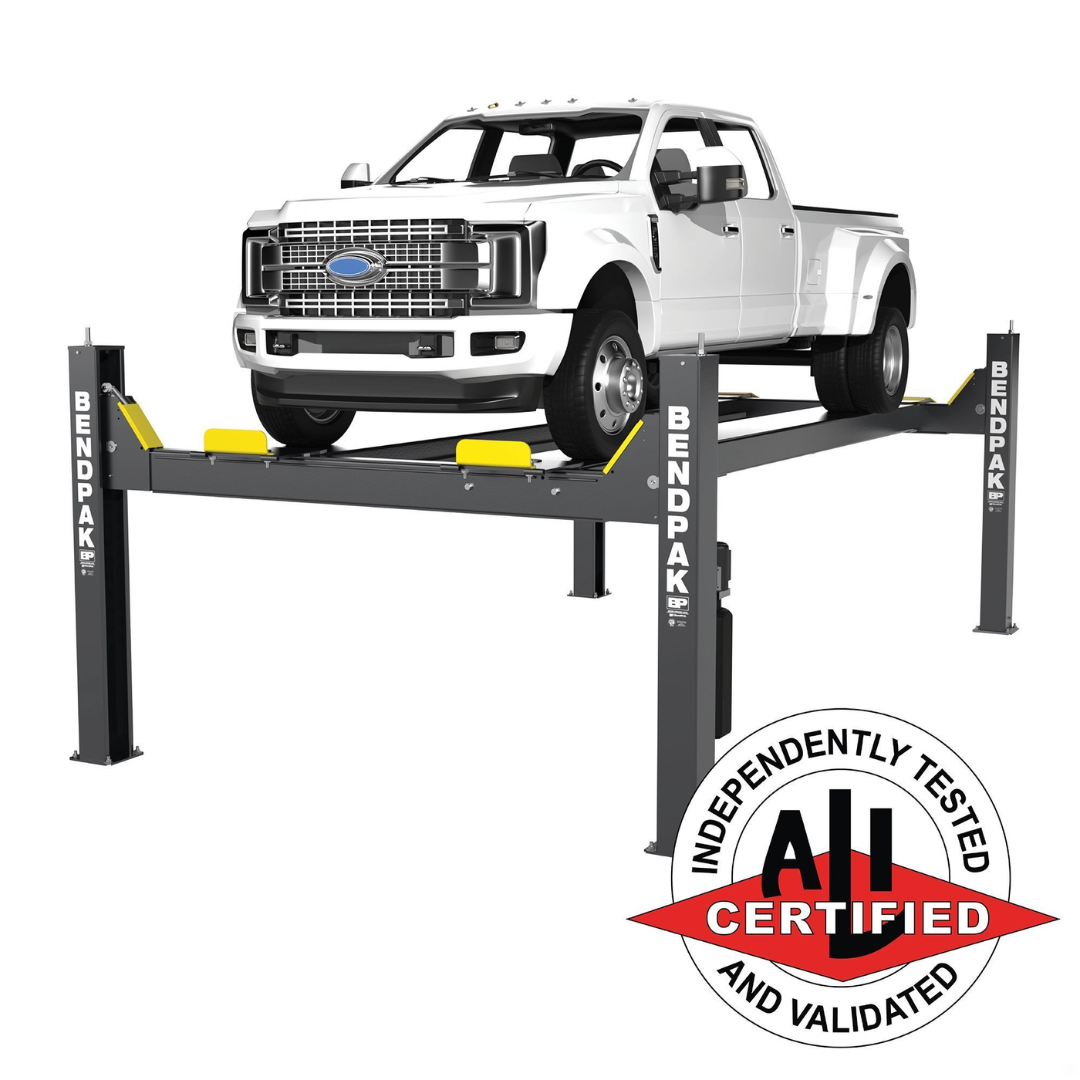
Built specifically for sustained heavy commercial use. 18,000 lb puts you into medium commercial vehicle territory, larger fleet vehicles, heavy-duty trucks, and work vans that a standard lift won't touch.
The optional HDS-18EA configuration adds alignment capability for shops combining heavy lifting with alignment services. If fleet maintenance contracts are part of your business model, this is the lift.
- 18,000 lb capacity for medium-duty trucks, commercial vans, and heavy fleet vehicles
- Purpose-built for sustained heavy commercial load cycles
- Wide runways for stable, secure loading on commercial vehicle platforms
- Optional alignment configuration (HDS-18EA) for combined heavy lift and alignment use
- ALI certified
- Free shipping
Mobile Column Lifts: When Fixed Lifts Are Not Enough
Mobile column lifts are in a different category from everything above. No fixed installation. No concrete spec requirements. The columns position independently around the vehicle's wheels, which means they adapt to any wheelbase, any vehicle length, any configuration a fixed lift can't accommodate.
Fleet operators, municipal shops, and commercial truck service centers use mobile column setups because they handle vehicles; fixed lifts simply won't.
Capacity runs from 14,000 lb per column to over 70,000 lb for a full set. Wireless control systems let a single technician manage all columns simultaneously. When the job is done, the columns store away, and the bay is back.
Our Mobile Column Lifts Pick
iDEAL MSC-18K-X-472 72,000 lb ALI Certified Mobile Column Lifts (Set of 4)
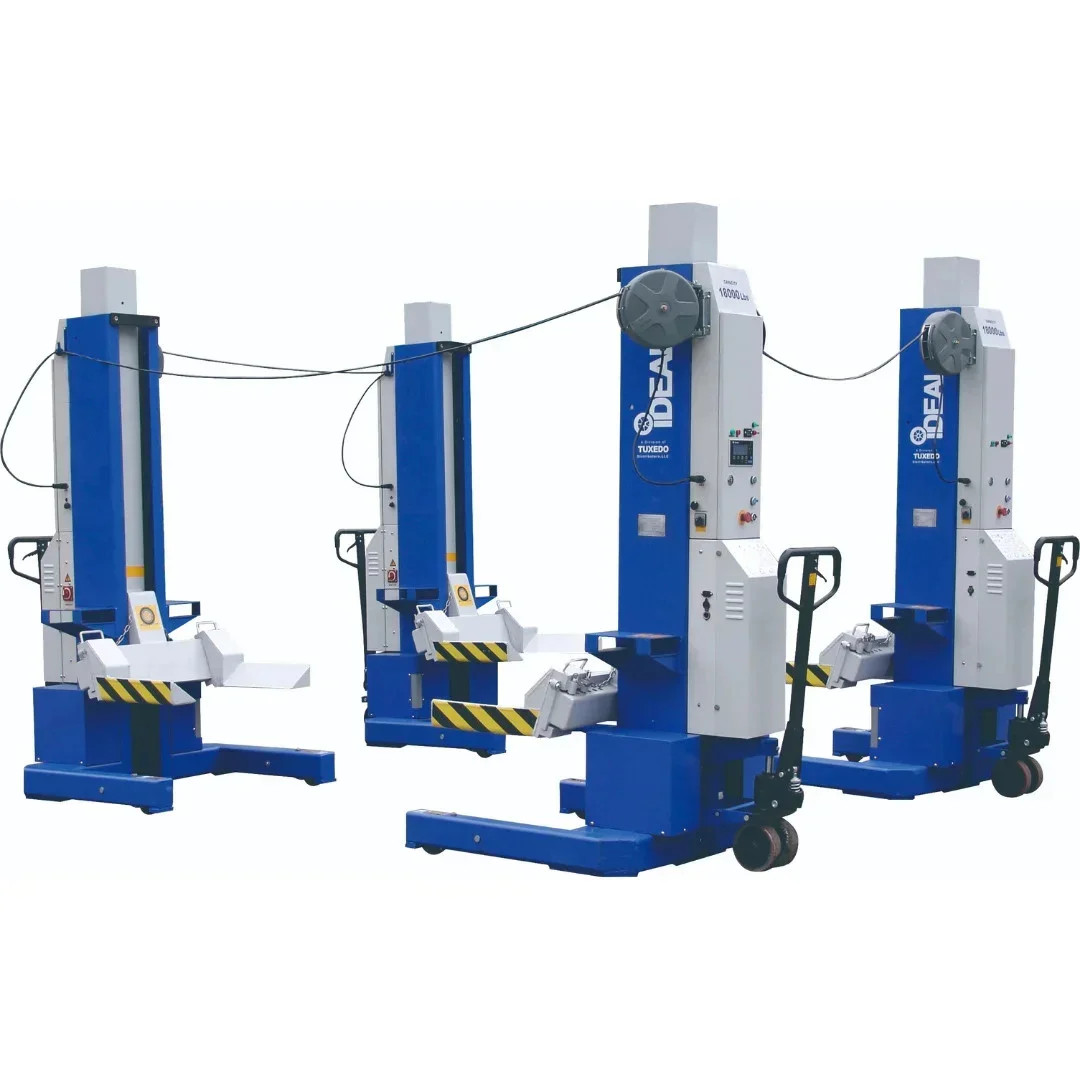
18,000 lb per column, 72,000 lb total for the four-column set. ALI certified. Wheel-engaging design for maximum vehicle stability across different platforms.
This is the lift for commercial shops targeting fleet maintenance contracts or servicing commercial vehicles that a fixed lift can't handle. No installation required means you can be lifting the day it arrives, and the bay stays flexible for everything else the rest of the time.
- 18,000 lb per column, 72,000 lb total capacity for the set of 4
- ALI certified to ANSI standards for professional commercial use
- Wheel-engaging design for stable, consistent lifting across vehicle types
- No permanent installation, reconfigurable, storable, operational on any flat surface
- Handles trucks, fleet vehicles, buses, and heavy commercial platforms
- Free shipping
Comparison Table: Professional Car Lifts for Auto Repair Shops
|
Lift |
Type |
Capacity |
Best Application |
|
2-Post |
10,000 lb |
High-volume commercial shop |
|
|
4-Post Alignment |
12,000 lb |
Wheel alignment work |
|
|
Scissor |
6,000 lb |
Fast-turnaround tyre and brake work |
|
|
Heavy-Duty 4-Post |
18,000 lb |
Fleet and medium commercial vehicles |
|
|
Mobile Column (x4) |
72,000 lb |
Fleet trucks, buses, heavy commercial |
How to Spec a Multi-Bay Shop Setup
Most professional shops need more than one lift type. Here's how to think through the setup by shop profile.
General repair shop (3-5 bays): Two or three 2-post lifts as the primary service bays, one 4-post handling alignment and overflow storage. The 2 posts run the volume; the 4 posts handle specialist work. That covers the majority of independent shop operations efficiently.
Alignment or tire center: A dedicated 4-post alignment lift is non-negotiable. The AMGO PRO-12A with integrated slip plates is the right alignment lift for professional use. Supplement with a 2-post for service work that doesn't need alignment capability.
Truck or fleet service shop: Standard 2-post capacity is usually insufficient for the vehicle mix. A BendPak HDS-18E handles the heavy end, with mobile column lifts for anything larger or with unusual wheelbases. If you're actively targeting fleet maintenance contracts, budget for a mobile column set from day one.
Mixed shop expanding vehicle range: BendPak 10AP PRO as your primary 2-post bay lift, AMGO PRO-12A for alignment, BendPak MD-6XP for fast-turnaround light service, and BendPak HDS-18E for the heavier end of the vehicle mix.
This combination gives you garage lifts for professional use across the full range of passenger cars through light commercial vehicles without over-specifying in any single direction.
Safety and Compliance for Commercial Shops
ALI certification is what your insurer checks and what OSHA inspectors look for. The Automotive Lift Institute independently tests to ANSI/ALI ALCTV standards. Every lift in this guide meets that standard. For shops in states with regular workplace safety inspections, ALI certification on every lift in your facility is baseline compliance.
OSHA standards under 29 CFR 1910 for general industry reference ALI certification in the context of automotive lift safety. OSHA doesn't mandate ALI certification by name, but uncertified equipment in a commercial shop creates a liability exposure that no business needs.
Maintenance and inspection schedules aren't optional in a commercial environment. Quarterly inspections of hydraulic seals, safety locks, cables, and arm pivot points. Annual third-party inspection for high-cycle commercial use. Keep a maintenance log. If something goes wrong and you can't demonstrate a documented maintenance history, your insurance position gets complicated fast.
Technician training on rated capacity, vehicle positioning, and lock engagement is a baseline requirement. Some states require documented lift operator training for commercial shops. Check your state's workplace safety requirements and keep training records.
Concrete specification for any permanent lift: minimum 4 inches, 3,000 PSI compressive strength, fully cured. Don't assume the floor is spec-compliant; verify it before installation. Mobile column lifts eliminate this requirement entirely if the slab is a concern.
Talk to JMC Before You Buy
Getting the lift specification right up front saves you money, hassle, and the cost of a replacement purchase years earlier than necessary.
Browse the full range of commercial car lifts at JMC Automotive Equipment or
Call 800-562-4791, and the team can walk you through your bay setup, vehicle mix, ceiling height, and concrete situation before you commit.
Financing available.
Frequently Asked Questions
What's the best car lift for a mechanic shop doing general repair work?
For most general repair shops, a 2-post lift in the 10,000-11,000 lb range is the right primary bay lift.
What's the difference between a 2-post and 4-post lift for a repair shop?
The 2-post gives you full undercarriage access and faster cycle times, which makes it better for repair and maintenance volume. The 4-post is more stable, easier to drive onto, and essential for alignment work. Most professional shops benefit from running both rather than choosing between them.
Do commercial car lifts need to be ALI certified?
For professional shop use, yes. ALI certification independently verifies load ratings and safety mechanisms. Most commercial insurance policies require it, and OSHA workplace safety standards reference ALI certification. Using uncertified equipment in a commercial shop creates a liability exposure that isn't worth the price difference.
What lift capacity do I need for a shop servicing trucks and SUVs?
For full-size pickup trucks, plan for a minimum 12,000-14,000 lb capacity. For cargo vans, heavy SUVs, or regular commercial vehicle work, 18,000 lb is the right starting point. Mobile column lifts handle anything beyond that range.
How long do commercial car lifts last?
A properly maintained, correctly specified commercial lift from a reputable brand runs 15-20 years under professional shop use. Variables include maintenance frequency, load cycles relative to rated capacity, and correct installation to spec. Parts availability and manufacturer support over that horizon matter more than most buyers account for at purchase time.
Is financing available for commercial shop lift equipment at JMC?
Yes. JMC offers financing, including 0% APR plans on most equipment. For a multi-lift shop setup with a large capital outlay, financing against the revenue the equipment generates is a straightforward approach to managing the total cost of ownership.
 CALL US NOW
